

Author: Dominic Goodsell, Content Writer and Practice Manager Family Practice Group
Alan Milburn's review will recommend that nobody under 25 can claim Personal Independence Payment or the health element of Universal Credit. Around 205,000 young people in that age group receive PIP with autism or ADHD recorded as their main condition, so this is the group with most at stake. The final report lands on Tuesday 17 November 2026. This post sets out what is confirmed, what is only reported, what the current system costs, and where the numbers being quoted do not hold up.
The key changes
We have to stress that the final report has not been published and is due on Tuesday 17 November 2026 (1). What follows comes from Milburn's own briefing to The Times and the BBC on 11 November (1, 2) and from his interim report of 28 May 2026 (3).
Seven changes are reported:
PIP ends for under-25s. Young people would no longer be able to claim Personal Independence Payment (1).
The Universal Credit health element ends too. Under-25s would instead receive a "youth allowance" paid at the standard Universal Credit rate (1, 4).
A narrower payment replaces PIP. An "additional cost allowance" would cover day-to-day costs linked to a condition. It would not be means-tested or tied to work, but fewer people would qualify (4, 5).
A higher-rate benefit for those who cannot work. Young people with the most severe disabilities would get a new, more generous payment (1).
Conditions come attached. Young people who do not engage with work support could lose part of their benefit. Milburn's line: "A deal isn't a deal unless there are potential consequences" (1).
Existing claimants are included. Milburn says the changes should apply to current claimants as well as new ones, and the government is reported to be planning legislation in the new year (1).
Billions go into employment support. One-to-one advisers, work placements and job subsidies would be funded up front. Savings to the Treasury could take almost a decade to appear (1).
Milburn admits some young people will receive less money at the start of a claim than they do now. Many claimants would be worse off under the plans, according to the BBC (1).
Two things are missing from everything published so far: the rate of the additional cost allowance, and the test for who gets it. Without those, nobody can calculate what an individual family stands to lose.
What the current system costs
No official figure exists for the total benefits bill for under-25s with autism or ADHD. The closest is a Nuffield Trust estimate: about £1.36bn in 2025/26 on PIP for 16 to 24-year-olds whose main recorded condition is autism or ADHD (6).
That covers just over 205,400 young people at April 2026, more than three times the 2019 number (6). The interim report says autism and ADHD account for nearly half of PIP claims among young people, against fewer than one in ten across all ages (3, 8).
Sources: Milburn interim report, May 2026 (total, PIP, UC health); Nuffield Trust, Sept 2026 (autism and ADHD PIP). 'Other' segments are our subtraction and mix 2024/25 and 2025/26 figures.
The interim report supplies the wider picture (3, 7):
Total spend. £8.1bn a year goes on key benefits for 16 to 24-year-olds across disability, incapacity and unemployment support.
PIP growth. PIP spending on this age group rose from £1.3bn to over £3bn in five years, and is projected to reach £6.5bn by 2031/32 (8).
Universal Credit health. Spending on young people rose from £1.5bn in 2019/20 to £2.1bn in 2024/25. About 260,000 young people receive the health element (9).
Support versus cash. For every £1 the DWP spent on employment support for young people in 2024/25, about £25 went on benefits (13).
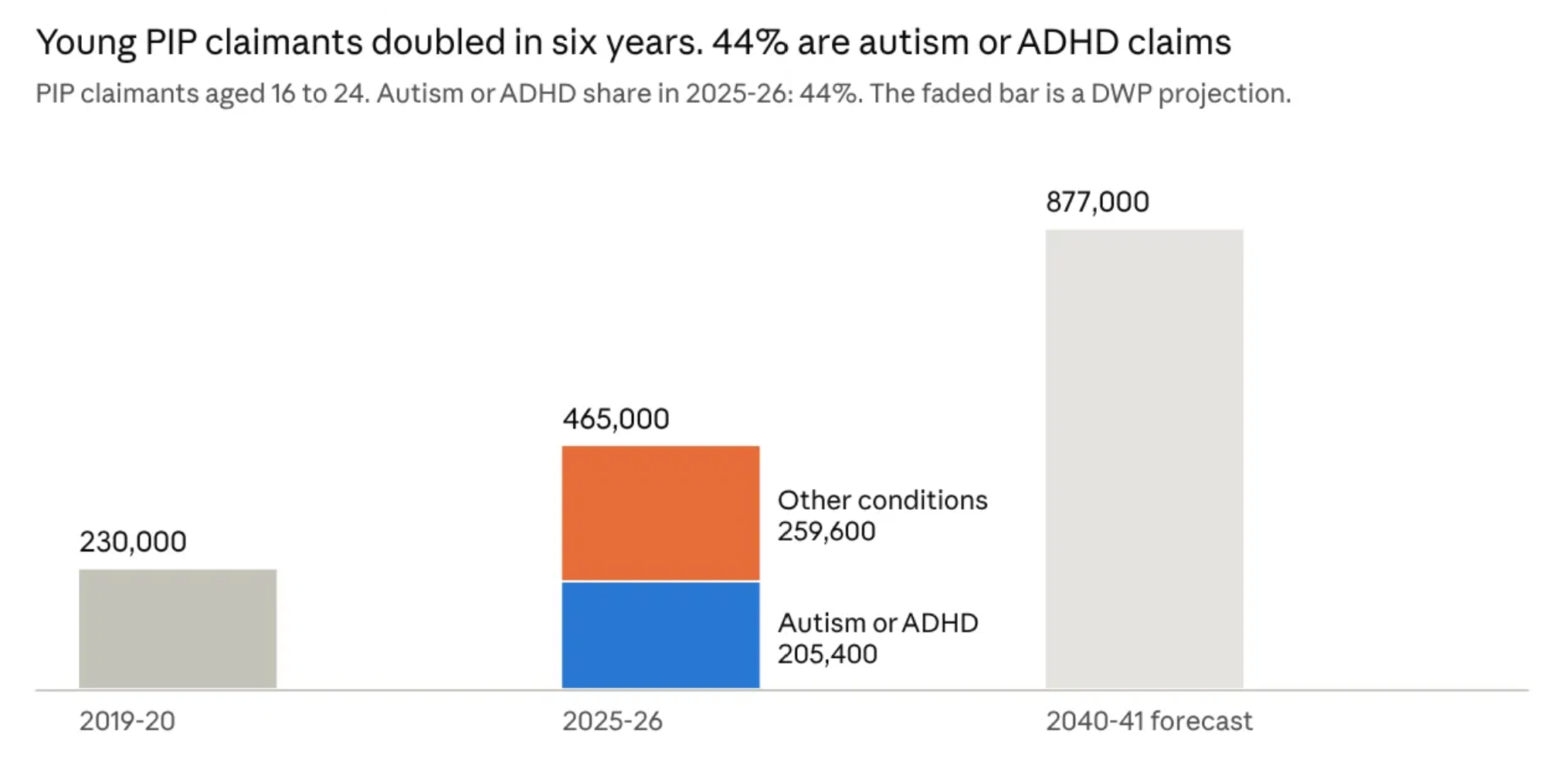
Sources: DWP figures reported June 2026 (totals and projection); Nuffield Trust analysis of Stat-Xplore at April 2026 (autism or ADHD). 'Other conditions' is derived by subtraction.
Caseload growth explains why ministers are looking here. The DWP projects the number of young PIP claimants nearly doubling again by 2040-41, at a cost of around £9.2bn a year (11).
Individual awards are substantial. Nuffield puts the average PIP payment to a 16 or 17-year-old with autism or ADHD at £169 a week, close to £8,800 a year (6). The Institute for Fiscal Studies reports that 54% of 18 to 24-year-old PIP claimants receive the highest award, worth about £10,000 a year, while 13% receive £4,000 or less (15).
Children under 16 sit outside the review because they claim Disability Living Allowance, not PIP. They are the pipeline, though. In 2023, four in five child DLA recipients in England and Wales (544,000 of 682,000) had a learning difficulty, behavioural disorder or ADHD as their main condition (16). Those children will turn 16 into whatever replaces PIP.
What the review proposes, and why
Milburn's argument is that the system pays young people for what they cannot do, then leaves them alone. He wants the money to buy participation instead (3).
His interim report supplies the evidence he leans on (3, 7):
Long stays. Of those who first claimed a health or disability benefit aged 16 to 24, 53% are out of work and education five years later. After fifteen years the figure is still 48%.
No conversation about work. PIP never asks a claimant about employment. Less than half of the £8.1bn has any participation support or requirement attached.
Thin support. Only about one in five NEET (Not in Education, Employment, or Training) young people in England gets meaningful employment help from the benefits system.
Appetite to work. 84% of NEET young people surveyed for the review want a job, education or training (13).
On autism and ADHD, the interim report argues that these conditions fluctuate and depend heavily on environment. Its conclusion is that a neurodevelopmental diagnosis should not settle whether a young person can work (8).
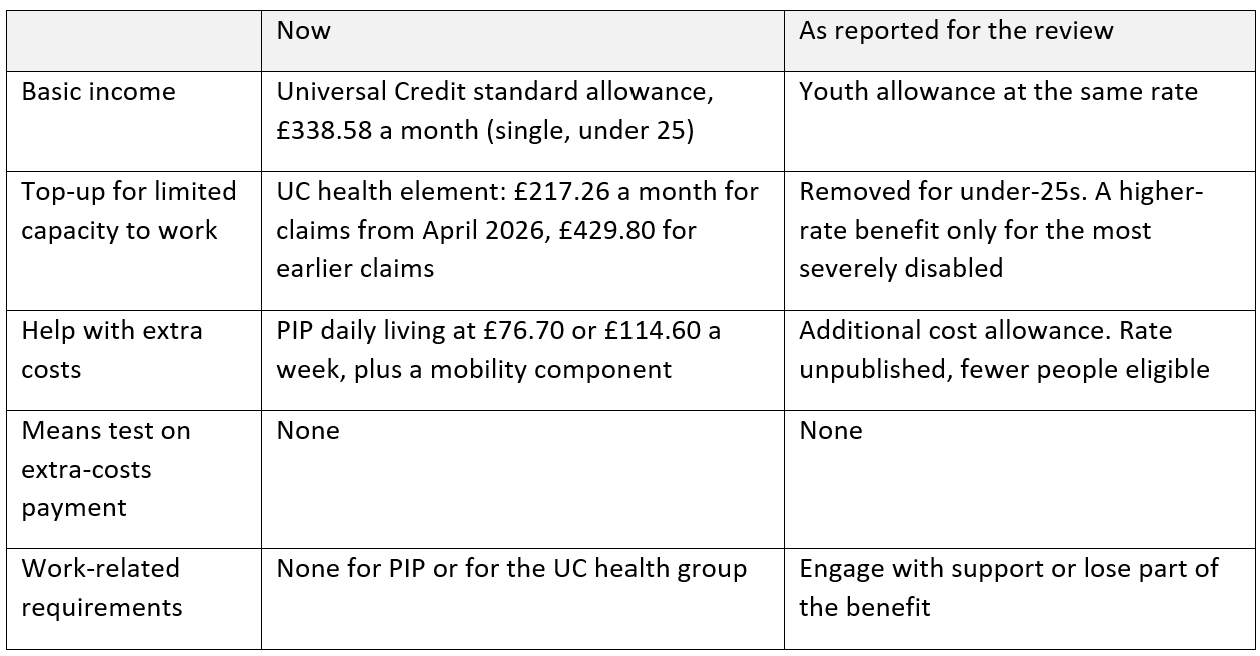
The employment side is where the new money goes. Reported measures include personal advisers, work placements, job subsidies, Danish-style "flexi-jobs", subsidised work for disabled young people and help for employers with workplace adjustments (1, 17).
The sums are tight. The Resolution Foundation estimates that matching average OECD spending on employment support would cost at least £5bn more a year, against a total youth benefits bill of £8.1bn. It also finds that the UC health element and PIP currently keep 120,000 young people out of poverty (9). Benefit cuts alone cannot pay for the support Milburn wants.
What it could mean for current claimants
Nobody can state an individual's loss yet, because the replacement rates are unpublished. The exposure can be measured.
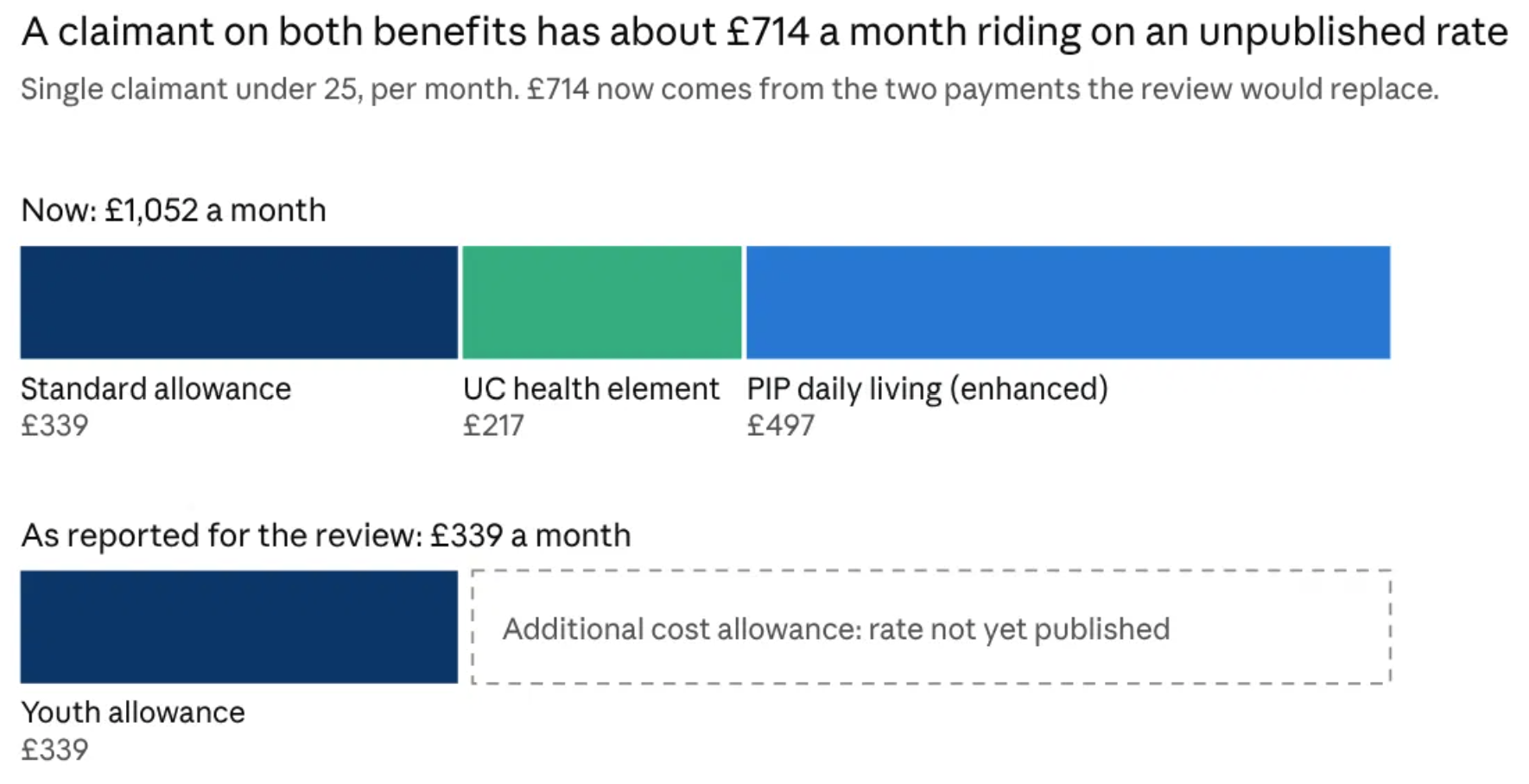
Illustrative only. Rates for 2026/27 from the House of Lords Library, 23 Oct 2026; weekly PIP converted to monthly (x52/12). Assumes a UC health claim made after April 2026 and no PIP mobility award.
The example is a single claimant under 25 who receives the enhanced daily living rate of PIP and started a Universal Credit health claim after April 2026 (5, 10). A claimant whose health element predates April 2026 receives £429.80 a month instead, which puts about £926 a month in play.
The effect depends on which group a young person falls into:
On PIP only. Many autistic and ADHD young people claim PIP while at college, at university or in work, and never claim Universal Credit. They would lose PIP and keep cash support only by passing the new additional cost test. Whether the youth allowance will be means-tested like Universal Credit has not been reported.
On Universal Credit health and PIP. This is the group in the chart and the most exposed. They would also face work-related requirements for the first time.
In work already. PIP is not an out-of-work benefit. The IFS found 21% of 18 to 24-year-olds on PIP were working in 2024 (15). The additional cost allowance is not tied to work status, so some of this group should keep help.
Highest support needs. A young person who cannot work should move to the new higher-rate benefit. The threshold has not been defined.
Turning 16. Teenagers on child DLA are currently invited to claim PIP at 16. Under the proposals they would be assessed for the new allowances instead.
The proposals already face resistance. The disability charity Sense supports the aim of getting more young disabled people into work but says it is "deeply concerned" that some will lose out without funded specialist support. Labour MP Bell Ribeiro-Addy has said she is unsure she could vote to cut entitlements for existing claimants (5).
Milburn's answer is that the current system favours a young person's short-term income over their long-term prospects, and that this is the wrong way round (1).
What happens next
Nothing has changed in law. Four steps stand between a recommendation and a different payment landing in anyone's account:
Publication. The final report is due on Tuesday 17 November 2026 (1).
Government response. The BBC reports that Prime Minister Andy Burnham is likely to back the recommendations, with legislation planned for the new year (1).
The Timms Review. Sir Stephen Timms's separate review of PIP for all ages is expected soon afterwards (5). The two will have to fit together.
Parliament. In 2025 ministers dropped a PIP eligibility clause from the Universal Credit Act after Labour backbench opposition (5). A measure that reduces existing awards faces the same test.
For families, three practical points follow:
Today's rules still apply. Existing awards continue, and a claim made now is decided under the current system.
Evidence of daily impact matters under either system. PIP turns on what a young person can do reliably. The reported additional cost allowance turns on the costs their condition creates. A diagnosis alone answers neither question, so keep records of both.
Read the report, not the headlines. The rates and the eligibility test will decide who loses. Neither has been published.
The review is right that a system which never asks an autistic 19-year-old about work has failed them. It has not yet shown that removing £700 a month is what gets them a job.
We will update this post when the final report is published.
References
All sources accessed 12 November 2026.
BBC News (Somerville E, Eardley N, Mason C). Some under-25s should get less benefits, Milburn review to say. 11 November 2026. Read through the Yahoo News syndication.
The Times. Milburn review calls for young people to be taken off sickness benefits. 11 November 2026. Paywalled. Content taken from references 1, 4 and 5.
Milburn A, Department for Work and Pensions. Young people and work: interim report. 28 May 2026. Figures taken as quoted in references 7, 8 and 13.
GB News. Young people to lose disability benefits as welfare system is 'rebuilt from scratch'. 12 November 2026.
Streamline Newsroom. Milburn review would end main disability benefits for under-25s. 12 November 2026. A news aggregator, used for its sourced summary of references 2, 10 and 15.
Gainsbury S, Vassiliou S, Sherlaw-Johnson C. PIP for ADHD and autism: a weakening link with deprivation? Nuffield Trust briefing. 22 September 2026.
O'Meara G. The Numbers and Drivers Behind Milburn's Young People and Work Interim Report. FE News. 29 May 2026.
Benefits and Work. Milburn report slams failure to link PIP to work. 1 June 2026.
Clegg A, Cominetti N. Can Milburn rise to the scale of Britain's NEETs challenge? Resolution Foundation. 11 November 2026.
House of Lords Library. Personal independence payment and other disability benefits and linked schemes. 23 October 2026. Rates taken as summarised in reference 5.
GB News. DWP alert: PIP bill for under-25s set to cost £9.2billion a year. June 2026. Reports DWP projections. The original DWP release was not located.
Big Issue. Disability campaigners criticise PIP cuts. October 2026. Reports Judge L, Murphy L, Hard truths: Rethinking Personal Independence Payment, Resolution Foundation, October 2026.
Hansard. Young People and Work: Milburn Interim Report. House of Commons debate. 3 November 2026.
Benefits and Work. Lords PIP debate shows 'cost-free conditions' claim is taking hold. 8 November 2026.
Latimer E, Oulton M, Tahir I, Xu X. Challenges for the Milburn Review. Institute for Fiscal Studies. 2026. Figures taken as summarised in reference 5.
Resolution Foundation. Growing Pressures. August 2024.
PA Media. Milburn review to call for young Neets to be located and monitored. November 2026.
Universal Credit health spending is not broken down by condition in any published source we could find.