
Author: Dominic Goodsell, Content Writer and Practice Manager Family Practice Group
"What if I mask so well that the assessor misses it?" It is the worry we hear most often from women seeking an autism assessment, and from parents of girls. With 336,764 people in England holding an open NHS referral for suspected autism in September 2026 (NHS England, November 2026), a great many families are asking the same question while they wait.
This post, written in November 2026, sets out what the research says masking is, what it is not, whether men and boys mask too, and whether clinicians can see past it. We have tried to separate what is well evidenced from what is still opinion, including our own.
The key points
Masking is real, and it has a research definition. It describes the strategies some autistic people use to hide or compensate for autistic traits in social situations.
It is not a diagnosis, and it is not proof of autism. Non-autistic people manage impressions too, and the questionnaire most often used to measure masking, the CAT-Q, picks up social anxiety as well.
Men and boys mask. On average autistic women report more of it, but the difference is modest and the overlap between the sexes is large.
No test can measure masking reliably enough to decide a diagnosis. The best-known tool, the CAT-Q, is useful for conversation but its own authors say it should not be used to decide whether someone is autistic.
A thorough assessment is designed to look past the surface. NICE guidance already tells assessors that signs may be masked and that good eye contact does not rule autism out.
The diagnostic gap is closing fast. Among school pupils in England there were 4.9 autistic boys for every autistic girl in 2016, and 2.8 in 2024. In NHS mental health services, women now receive 64% of adult autism diagnoses.
What masking is
Researchers usually use the word camouflaging, with masking as one part of it. A systematic review of 29 studies describes camouflaging as the behavioural and cognitive strategies autistic people use to adapt to, or cope within, a mostly non-autistic social world (Cook and colleagues, Clinical Psychology Review, 2021).
Three strands are usually described. Masking means hiding autistic characteristics, such as suppressing stimming or forcing eye contact. Compensation means working around a difficulty, for example rehearsing scripts or copying how a classmate talks. Assimilation means trying to blend in with others so as not to stand out.
It often has a cost. In adults, higher self-reported camouflaging is consistently linked with anxiety, depression and lower wellbeing, although the studies are snapshots and cannot show that one causes the other (Cook and colleagues, 2021). Many parents will recognise the pattern of a child who holds it together all day at school and falls apart at home. We cover the adult picture in our post on the signs of autism and ADHD in women.
Trying to mask is different from succeeding. Researchers separate camouflaging intent, meaning how hard someone tries, from camouflaging efficacy, meaning whether others actually see them as typical. A 2026 review of 389 studies stresses that a person can put great effort into blending in and still be perceived as different (Arnold, Bitsika and Sharpley, Autism, 2026). That distinction matters a great deal for assessment, and we return to it below.
What masking is not
Social media has stretched the word a long way. The research supports a narrower meaning.
It is not a type of autism. The researchers who developed the concept say plainly that camouflaging is not a core diagnostic feature and that they never proposed "camouflaged autism" as a subtype (Lai and colleagues, JCPP, 2021).
It is not lying. Much masking is learned in childhood as self-protection, and some of it is not conscious at all.
It is not unique to autistic people. Everyone adjusts how they come across. A recent clinical commentary describes camouflaging as a form of impression management shaped by social demands (ACAMH, October 2026).
It is not the same as social anxiety, although the two overlap. One prominent critic has pointed out that several questionnaire items read like social anxiety questions (Fombonne, interviewed by The Transmitter, 2020).
It is not evidence of autism by itself. Feeling that you perform a role in company is a real and often tiring experience, but it has many possible explanations, including anxiety, trauma and ADHD.
It does not make autism invisible. A diagnosis still requires evidence of autistic traits across a person's life. Masking can explain why that evidence is subtle or shows up only in some settings. It cannot stand in for the evidence altogether.
That last point works both ways. An assessment that takes masking seriously will sometimes conclude that a person is not autistic, and that is a sign of a careful assessment, not a careless one.
Can men mask?
Yes. The first study to put a number on camouflaging compared 60 autistic men and women matched for age and IQ. Women scored higher on average, but the authors reported substantial variability in both groups, and in men higher camouflaging was linked with more depressive symptoms (Lai and colleagues, Autism, 2017).
The average difference is real but modest. A meta-analysis of ten studies and 1,172 participants found that autistic women scored higher than autistic men on the main questionnaire, with a standardised difference of about 0.3, which statisticians would call small (Cruz and colleagues, Neuropsychology Review, 2025). In the 2021 systematic review, 12 studies found more camouflaging in females, the rest found no difference, and none found more in males (Cook and colleagues, 2021).
Among people without a diagnosis the sex difference disappears. One study compared diagnosed autistic young adults with undiagnosed young adults who had high autistic traits. Diagnosed women camouflaged more than diagnosed men, but there was no sex difference in the undiagnosed group. The authors suggest that effective camouflaging may delay diagnosis for both men and women (Milner and colleagues, Autism Research, 2023).
In our own work we see boys and men who mask, and the research supports that experience. A quiet, compliant boy who copies his friends can be missed for exactly the same reasons as a girl.
Why the focus is on women and girls
If men mask too, why is almost everything written about women? There are four main reasons.
Autism was described in boys first. For decades the accepted ratio was four males to every female, and the diagnostic criteria and observation tools were developed largely on male samples.
Women are diagnosed later. In two samples of autistic adults, women were diagnosed later than men on average, and women who reported the most camouflaging were diagnosed latest (Milner and colleagues, Autism Research, 2024).
The research itself has mostly studied women. The 2026 review found that camouflaging studies have focused on women diagnosed in adulthood without intellectual disability. Men, children and people with higher support needs are under-represented (Arnold, Bitsika and Sharpley, 2026).
The story is compelling. Accounts from late-diagnosed women are powerful and widely shared, and they have rightly changed practice.
There is a risk in this. Treating masking as a female presentation can create a new stereotype while trying to correct an old one (ACAMH, October 2026). A good assessor asks every client about masking, whatever their sex or gender.
Is masking really defeating assessors? The national figures
If masking routinely fooled clinicians, we would expect the gap between male and female diagnosis to stay wide. It has narrowed quickly. We set out the longer trend in our post on whether autism is really more common in boys than girls.
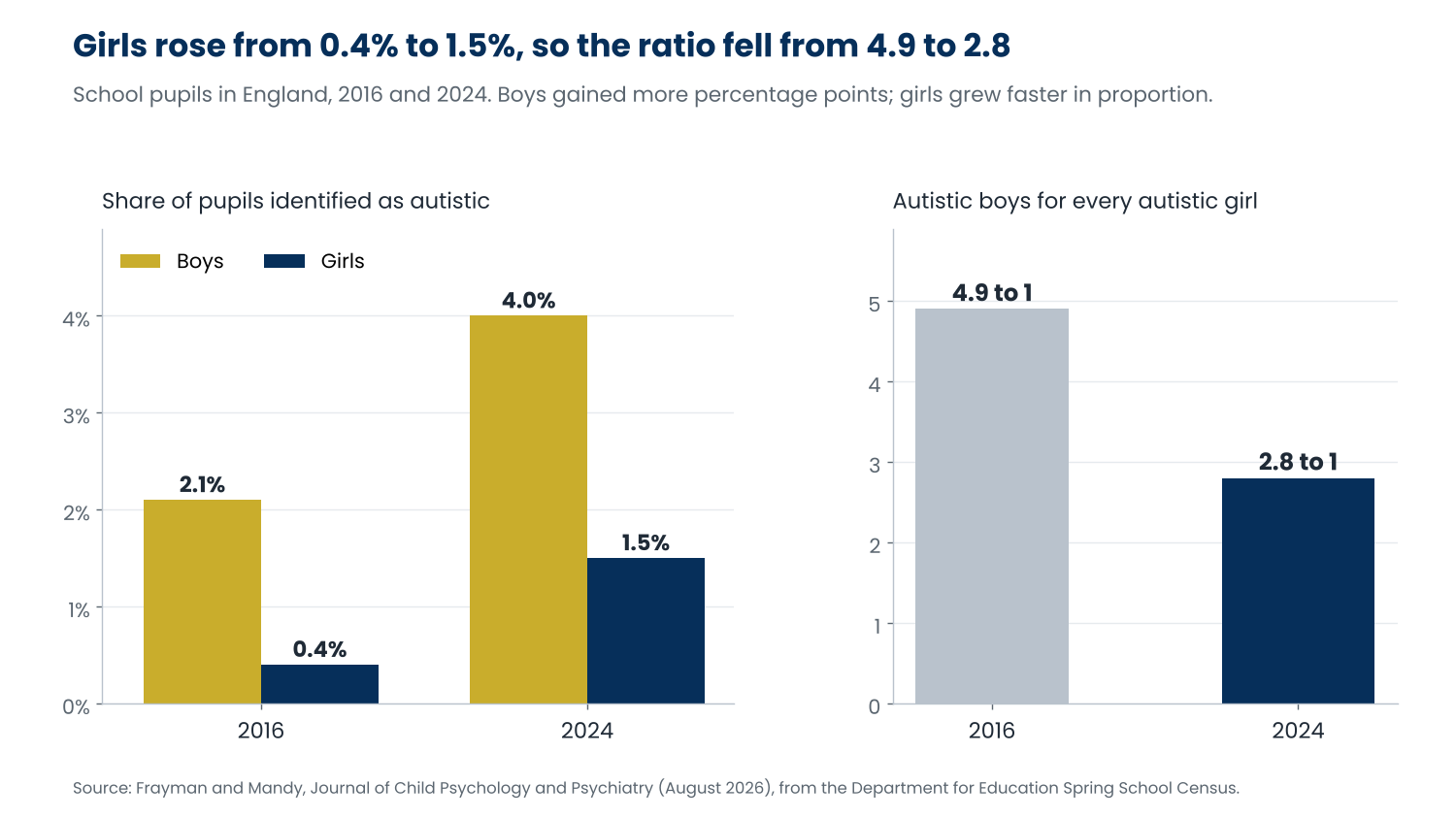
In England's schools the ratio has almost halved. Between 2016 and 2024 the share of pupils identified as autistic rose from 1.5% to 3.3%. Among girls it went from 0.4% to 1.5%, nearly four times higher. Among boys it went from 2.1% to 4.0%. The male-to-female ratio fell from 4.9 to 1 to 2.8 to 1 (Frayman and Mandy, JCPP, August 2026). Our earlier post quoted a separate study of the 2017 census, which reported higher figures for both sexes (2.81% of boys and 0.65% of girls). The two studies used different methods, so their figures should not be read as a year-on-year change.
GP records tell a similar story from an earlier date. At the end of 2018, 1.22% of males and 0.35% of females in England had an autism diagnosis on their GP record, a ratio of roughly 3.5 to 1 (O’Nions and colleagues, The Lancet Regional Health Europe, 2023). The same study estimated that well over half of autistic people in England may still be undiagnosed.
Girls catch up in their teens. A Swedish study followed more than 2.7 million people born between 1985 and 2020. Boys were diagnosed far more often in childhood, but by age 20 the cumulative ratio in 2022 was 1.2 males to every female (Fyfe and colleagues, The BMJ, February 2026). Sweden is not England, and the authors do not claim to know why girls are diagnosed later.
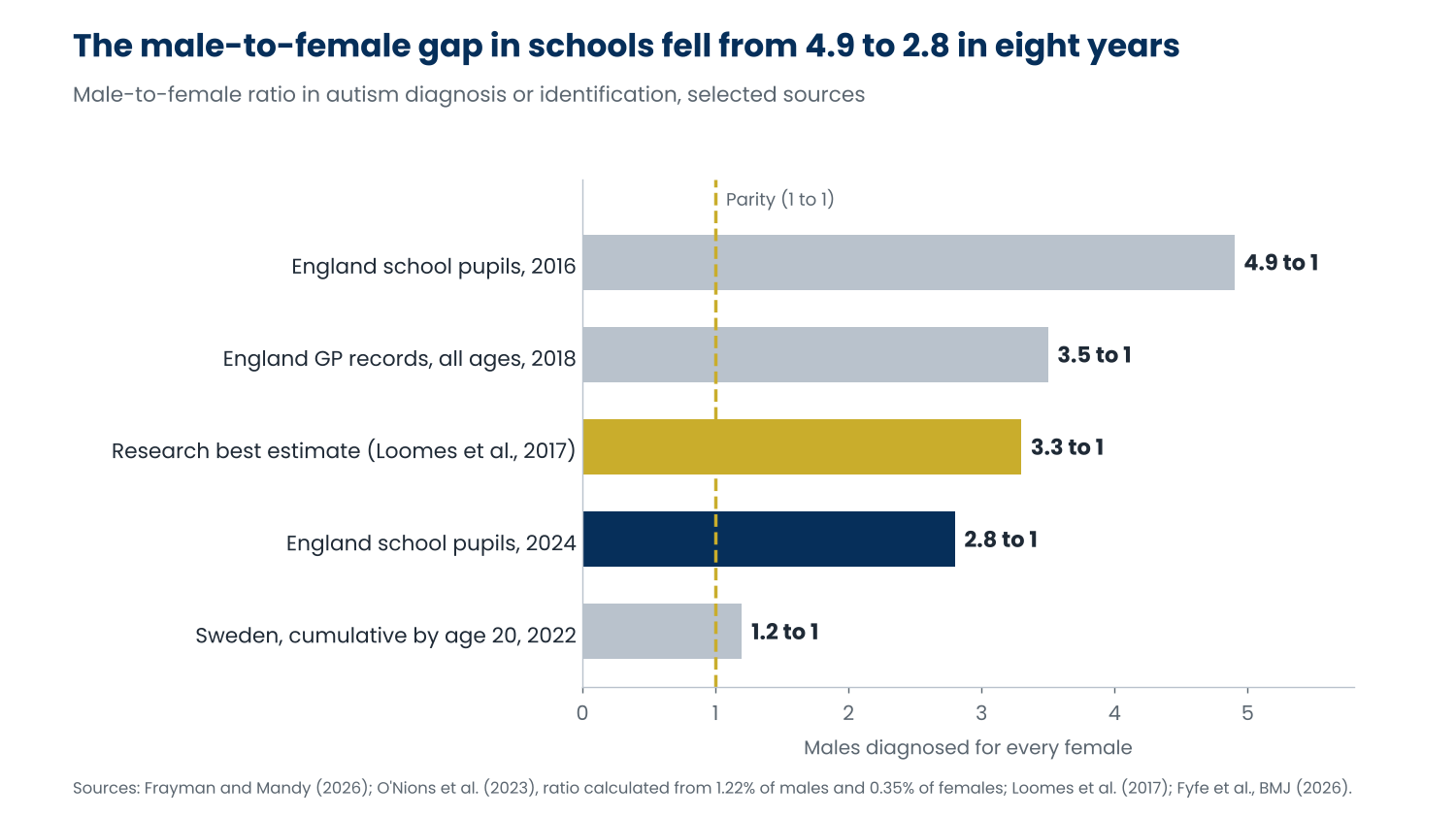
What we take from this. The concern is not media hype. Girls and women were under-identified for a long time, and many are still diagnosed years later than boys. But the same figures show that services are finding them in growing numbers. Masking is one explanation among several. Others include criteria built on boys, teachers and GPs being quicker to refer boys, and girls' difficulties being put down to anxiety or low mood. The problem has been slow recognition more than an undetectable presentation.
In NHS mental health services, women are now the majority. Between April 2025 and September 2026, females made up 54% of new referrals for suspected autism and 56% of recorded autism diagnoses. Among adults the gap is wide: 11,405 women received a diagnosis against 6,470 men, which is 64% of the adult total. Among under-18s the split was closer, with 8,345 boys and 7,460 girls (NHS England, November 2026).
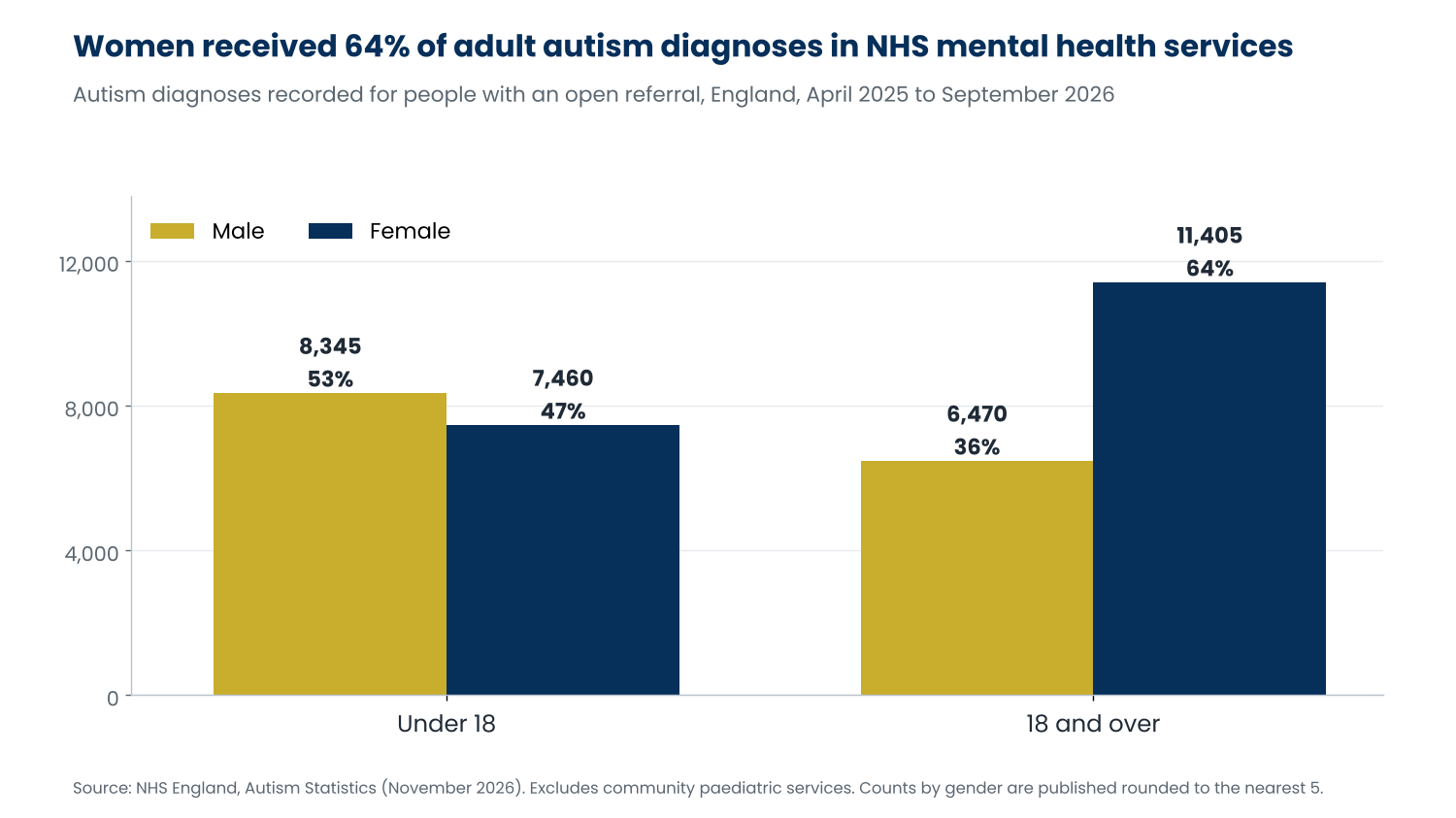
Read these figures with care. They leave out community paediatric services, where many young boys are assessed, and most referral outcomes are never recorded. Monthly diagnosis counts also roughly doubled from March 2026 for both sexes at once, which points to a change in which providers send data. The figures tell us who is coming forward and being diagnosed today, and much of that is women catching up after years of being missed. They do not show that autism is more common in women.
Are there reliable tests for masking?
There are tools, and they are helpful, but none is reliable enough to settle a diagnosis.
The CAT-Q. The Camouflaging Autistic Traits Questionnaire is a 25-item self-report measure for people aged 16 and over, with compensation, masking and assimilation subscales. In a study of 306 autistic and 472 non-autistic adults, autistic women scored higher than autistic men, and there was no sex difference among non-autistic adults (Hull and colleagues, Autism, 2020).
It was carefully built. The CAT-Q was developed from autistic adults' own descriptions of masking and tested on 354 autistic and 478 non-autistic adults. It proved internally consistent, gave similar results when 30 people repeated it three months later, and showed the same structure in men and women (Hull and colleagues, Journal of Autism and Developmental Disorders, 2019). Its authors said from the start that its usefulness in clinics still had to be established.
Its limitations are also well documented:
It measures intent, not success. It records how much someone says they try to camouflage. It cannot capture masking a person is not aware of.
It overlaps with social anxiety. The 2026 review of 389 studies found excellent reliability but mixed support for validity, with scores confounded by social anxiety and limited specificity to autism (Arnold, Bitsika and Sharpley, 2026). The CAT-Q's authors read the same link differently: they expected masking and social anxiety to rise together and treat it as support for the tool. The question is not settled.
It does not line up well with what clinicians observe. In a Dutch study of 674 adults, CAT-Q scores correlated only weakly (between 0.04 and 0.28) with the gap between self-reported traits and ADOS-2 observation. Unlike the original study, it also found that the questionnaire did not work the same way in autistic and non-autistic adults (University of Amsterdam replication study, 2023).
Its authors warn against diagnostic use. The team behind the CAT-Q published guidance in 2026 recommending that clinicians do not use it to assess whether someone is autistic (Hannon and colleagues, 2026).
Discrepancy methods. Researchers sometimes estimate masking as the gap between how autistic someone appears in observation and how they score on self-report or cognitive tests. These are research methods, not clinical tests, and the review authors question whether laboratory tasks are a fair proxy for someone's "true" autistic status (Cook and colleagues, 2021).
The standard assessment tools. The ADOS-2 and ADI-R do not measure masking directly (Milner and colleagues, 2024). That is why neither should ever be used alone, and why clinical judgement across several sources of information matters so much.
Can an experienced psychologist tell?
In our opinion, yes: a trained and experienced psychologist carrying out a thorough assessment can usually recognise masking. We want to be open about how far the published evidence backs that view.
What supports it.
National guidance assumes it. NICE tells assessors that signs in older children may have been masked by coping mechanisms or a supportive environment, that autism may be under-recognised in girls, and that eye contact, smiling and affection should not be used to rule autism out (NICE CG128, checked November 2026).
Most clinicians already look for it. In a survey of 41 clinicians who diagnose autism in adults, 73.2% said they routinely assess for camouflaging, and it shaped their choice of tools, their interview questions and how they interpreted results (Tassone and colleagues, Research in Autism, 2026).
Trying to mask does not reliably change how a person comes across. Feeling that you mask heavily is not the same as hiding autism from other people. In one small study, 127 observers rated ten-second clips of 40 adults, half of them autistic. How hard someone said they camouflaged did not predict the impression they made (Belcher and colleagues, Journal of Autism and Developmental Disorders, 2022). The observers were rating first impressions, not spotting autism, and the same study found that people who made better first impressions were diagnosed later.
Our reading is that first impressions are a poor guide either way. A thorough assessment does not rely on how someone comes across in the room. It draws on their developmental history, the people who know them and how they manage across different settings.
What qualifies it?
No study has directly tested how accurately clinicians detect masking. There is no published accuracy figure, for us or for anyone else.
Heavy masking is linked with later diagnosis. In the Milner study, women who reported the most camouflaging were diagnosed latest, and the Belcher study found the same for people who made better first impressions.
Autistic adults report a gap. In the Tassone survey, fewer autistic adults recalled being asked about camouflaging than clinicians said they asked.
So the honest position is this. Masking can delay recognition, particularly where an assessment is brief or relies on a single observation. The evidence does not show that it defeats a comprehensive, multi-source assessment, and the guidance is written on the assumption that skilled assessors can account for it.
How our assessments look for masking
Masking mostly affects what can be seen in one room on one day. A thorough assessment does not depend on that.
A developmental history. Masking is learned over time. We complete a structured developmental interview (the ADI-R) with a parent or other informant, lasting around 90 minutes to two hours, which looks back to early childhood before those strategies were established.
More than one informant and more than one setting. For children we ask parents and, with consent, the school to complete structured questionnaires. For adults we ask someone who has known the person for years. A marked difference between home and school is itself useful evidence.
Observation by a psychologist. The ADOS-2 is carried out by an HCPC registered psychologist with specific ADOS training. We look at how social interaction is achieved and what it costs, not only whether eye contact or conversation is present.
The person's own account. Self-report questionnaires and interview give room to describe rehearsing, copying, exhaustion after socialising and the need to recover.
The wider picture. Our questionnaires also cover sensory processing, mental health, trauma, ADHD and adaptive behaviour, so that other explanations are properly considered.
A team view. We work as a multi-disciplinary team in line with NICE guidance, led by a Consultant HCPC Registered Psychologist with more than 16 years' experience.
NICE asks for exactly this breadth. For children, where reported signs and clinic observations do not match, it advises considering further observation in other settings (NICE CG128, checked November 2026). For adults, it expects a team-based assessment by trained professionals that involves an informant or documentary evidence such as school reports (NICE CG142, checked November 2026). The steps are set out in full on our child and adult assessment pages.
When the outcome is not autism
Some people come to us certain that they are autistic and masking, and leave without a diagnosis. That is hard to hear, and we do not take it lightly.
Masking was part of the question. We consider it throughout the assessment: in the developmental history, in what informants describe and in how a person presents across different settings.
A diagnosis needs evidence beyond the feeling of masking. The criteria require autistic traits that began in early development and show across a person's life. Masking can explain why those traits are subtle. When the history, the informants and the observation do not show them, masking alone cannot fill the gap.
Another explanation is a finding, not a brush-off. Social anxiety, trauma, ADHD and other conditions can produce the same sense of performing and the same exhaustion. Naming the right one matters, because the support that helps is different.
You can ask us how we reached the outcome. Your report sets out the tests we used and their results, and the feedback appointment is the place to ask how masking was weighed. If you think something was missed, tell us and bring any further evidence, such as old school reports.
Practical advice for families
Tell the assessor you are worried about masking. Tell us during your intitial consultation. It helps us ask the right questions.
Bring the evidence from outside the room. Old school reports, a diary of what happens after school or work, and examples of the gap between public and private behaviour are all valuable.
Choose your informant with care. The best informant is someone who sees the person when the mask is off.
Do not try to perform either way. There is no need to exaggerate or to suppress. If you notice yourself masking during the appointment, say so.
Ask any provider how they assess. Who carries out the assessment and what are their qualifications? Do they take a developmental history? Do they gather information from more than one source? Do they ask about masking directly? We covered what makes a private assessment credible in our post on whether private autism assessments are accepted.
The short version is this
Masking is real, it is tiring, and it has contributed to girls and women being recognised late. It is also not exclusive to women, not a diagnosis in itself, and not something a questionnaire can measure with confidence. National figures show the gap between male and female diagnosis narrowing year by year, which suggests that assessors are getting better at seeing it. A thorough assessment that takes a full history, hears from several people and is led by experienced clinicians is built to look beneath the surface, and that is the standard we hold ourselves to.
References
Official statistics and standards
NHS England Digital, Autism Statistics, October 2025 to September 2026, published 12 November 2026. Figures by gender are our analysis of the England data files for April 2025 to September 2026.
NICE, Autism spectrum disorder in under 19s: recognition, referral and diagnosis (CG128), recommendations.
NICE, Autism spectrum disorder in adults: diagnosis and management (CG142), recommendations.
Research on diagnosis rates
Frayman D and Mandy W, Rising autism identification in England, 2016 to 2024: evidence from England’s School Census, Journal of Child Psychology and Psychiatry, 18 August 2026.
O’Nions E and colleagues, Autism in England: assessing underdiagnosis in a population-based cohort study, The Lancet Regional Health Europe, April 2023.
Fyfe C and colleagues, Time trends in the male to female ratio for autism incidence, The BMJ, 4 February 2026.
Research on masking and camouflaging
Cook J, Hull L, Crane L and Mandy W, Camouflaging in autism: a systematic review, Clinical Psychology Review, 2021 (accepted manuscript).
Lai M-C and colleagues, Quantifying and exploring camouflaging in men and women with autism, Autism, 2017.
Hull L and colleagues, Development and validation of the Camouflaging Autistic Traits Questionnaire (CAT-Q), Journal of Autism and Developmental Disorders, 2019.
Hull L and colleagues, Gender differences in self-reported camouflaging in autistic and non-autistic adults, Autism, 2020.
Cruz S and colleagues, Is there a bias towards males in the diagnosis of autism? A systematic review and meta-analysis, Neuropsychology Review, 2025.
Milner V and colleagues, A comparison of self-report and discrepancy measures of camouflaging, Autism Research, 2023.
Milner V and colleagues, Does camouflaging predict age at autism diagnosis? A comparison of autistic men and women, Autism Research, 2024.
Belcher H and colleagues, Camouflaging intent, first impressions, and age of ASC diagnosis in autistic men and women, Journal of Autism and Developmental Disorders, 2022.
University of Amsterdam, How to measure camouflaging? A conceptual replication of the validation of the CAT-Q in Dutch adults, Research in Autism Spectrum Disorders, February 2023.
Arnold W, Bitsika V and Sharpley C, Camouflaging and autism: conceptualisation and methodological issues, Autism, 2026.
Hannon B, Hull L, Lai M-C, Magiati I and Mandy W, The use and misuse of the Camouflaging Autistic Traits Questionnaire in autism research and clinical practice, 2026.
Tassone A and colleagues, Autistic and clinician perspectives on the influence of camouflaging in adult autism assessments, Research in Autism, 2026.
Lai M-C and colleagues, Commentary: camouflaging in autistic people, reflection on Fombonne (2020), Journal of Child Psychology and Psychiatry, 2021.
Commentary and news reports
The Transmitter, Spotting the problems with camouflaging in autism research, interview with Eric Fombonne, 2020.
Musich F, Rethinking autistic camouflaging, ACAMH blog, 5 October 2026.
All sources were checked on 15 November 2026.