

Author: Dominic Goodsell, Content Writer and Practice Manager Family Practice Group
Is autism really four times more common in boys than in girls, and is it becoming more common at all? In England, the share of 6 to 11 year olds with an autism diagnosis in their health record rose from 0.24% in 2000 to 4.58% in 2025, and 294,792 people were waiting on an open referral for suspected autism in June 2026. This post, written on 15 November 2026, looks at what the evidence says about autism in males and females, how diagnosis rates in England and Wales have changed since the first studies, and what that means for families.

It is written for anyone who wants to understand how autism can present differently in males and females, and for those who think they, or their child, may be autistic.
What is the same?
The diagnostic criteria do not change with sex. A clinician assessing a boy, a girl, a man or a woman is looking for the same two things: lifelong differences in social communication and interaction, and restricted or repetitive patterns of behaviour, interests or activities. Sensory differences, such as being over or under-sensitive to noise, light, texture or taste, sit within that second group.
The core experiences are shared too. Autistic males and females alike often describe:
finding unwritten social rules hard to read, and conversation tiring
a strong need for routine and predictability, and distress when plans change
deep, absorbing interests
sensory overload in busy, bright or noisy places
needing time alone to recover after social demands.
Co-occurring difficulties are common in both sexes. The independent review found that anxiety, depression, eating disorders and self-harm are all substantially more common among autistic people than in the general population. ADHD frequently occurs alongside autism, and since 2013 the two can be diagnosed together.
What can look different?
The differences lie less in what autism is and more in how it shows, and in whether the adults around a child notice it. The National Autistic Society describes several patterns. None applies to every girl or every boy, and plenty of autistic boys fit the so-called female pattern.
Social difficulties may be less visible. Girls are more likely to be part of a friendship group, often on its edge or attached to one close friend. Teachers see a child who has friends and look no further.
Interests can look ordinary. A boy's fascination with train timetables stands out. A girl's fascination with animals, books, a band or a television series may not, even when the intensity is the same.
Repetitive behaviour can be quieter. Hair twirling, skin picking or re-reading the same book attracts less attention than hand flapping or lining up objects.
Distress is more often turned inwards. Girls are more likely to hold themselves together at school and fall apart at home, so parents and teachers describe two different children. Boys are more often referred because of behaviour that disrupts a classroom.
Another diagnosis often comes first. Women and girls may be diagnosed with anxiety, depression, an eating disorder or a personality disorder, with the autism underneath missed.
Diagnosis comes later. In a Swedish study of 2.7 million people, new diagnoses peaked at ages 10 to 14 for males and 15 to 19 for females (The BMJ, February 2026).
The tools were built around boys. Early autism research involved mostly male children, and the questionnaires and observation schedules that followed were tested largely on them. The National Autistic Society notes that these tools may be less sensitive to traits more common in women and girls. We wrote about how this affects adults in our earlier post on autism and ADHD in adult females.
How diagnosis rates have changed since the first studies
We set out to find diagnosis rates for England and Wales back to 1980. No national diagnosis data exists for that year. GP records only become usable for this purpose from the late 1990s. What we do have before then are a small number of local studies that counted autistic children directly.
1966: about 4.5 in every 10,000 children. Victor Lotter's survey of 8 to 10 year olds in Middlesex was the first of its kind, and found 2.6 boys for every girl (Lotter, 1966).
1979: about 20 in every 10,000. Lorna Wing and Judith Gould's study in Camberwell, south London, used a wider definition that became the basis of the autism spectrum (National Autistic Society).
1980: autism gets its own diagnostic category. The American diagnostic manual, DSM-III, listed infantile autism separately for the first time. Before this, many autistic children were recorded under other labels or none.
1990s: Asperger syndrome is added. The international and American manuals of 1992 and 1994 brought in people without a learning disability or language delay.
2006: about 116 in every 10,000, or just over 1%. A study of 9 and 10 year olds in the South Thames region produced the figure that became the familiar 1 in 100.
1998 to 2018: a 787% rise in recorded new diagnoses. A study of GP records covering more than 9 million patients found the rate of new autism diagnoses rose almost ninefold in 20 years (Russell and colleagues, 2022).
The last five years. The rise has continued and, according to the independent review, has been fastest since 2020 and among under-25s. Pupils with autism recorded as a special educational need went from 1.5% in 2016 to 3.3% in 2024. The share of adults telling the GP Patient Survey they are autistic rose from 1.4% in 2022 to 2.6% in 2025, and among 16 to 24 year olds from 5.4% to 8.9%.
The key figures
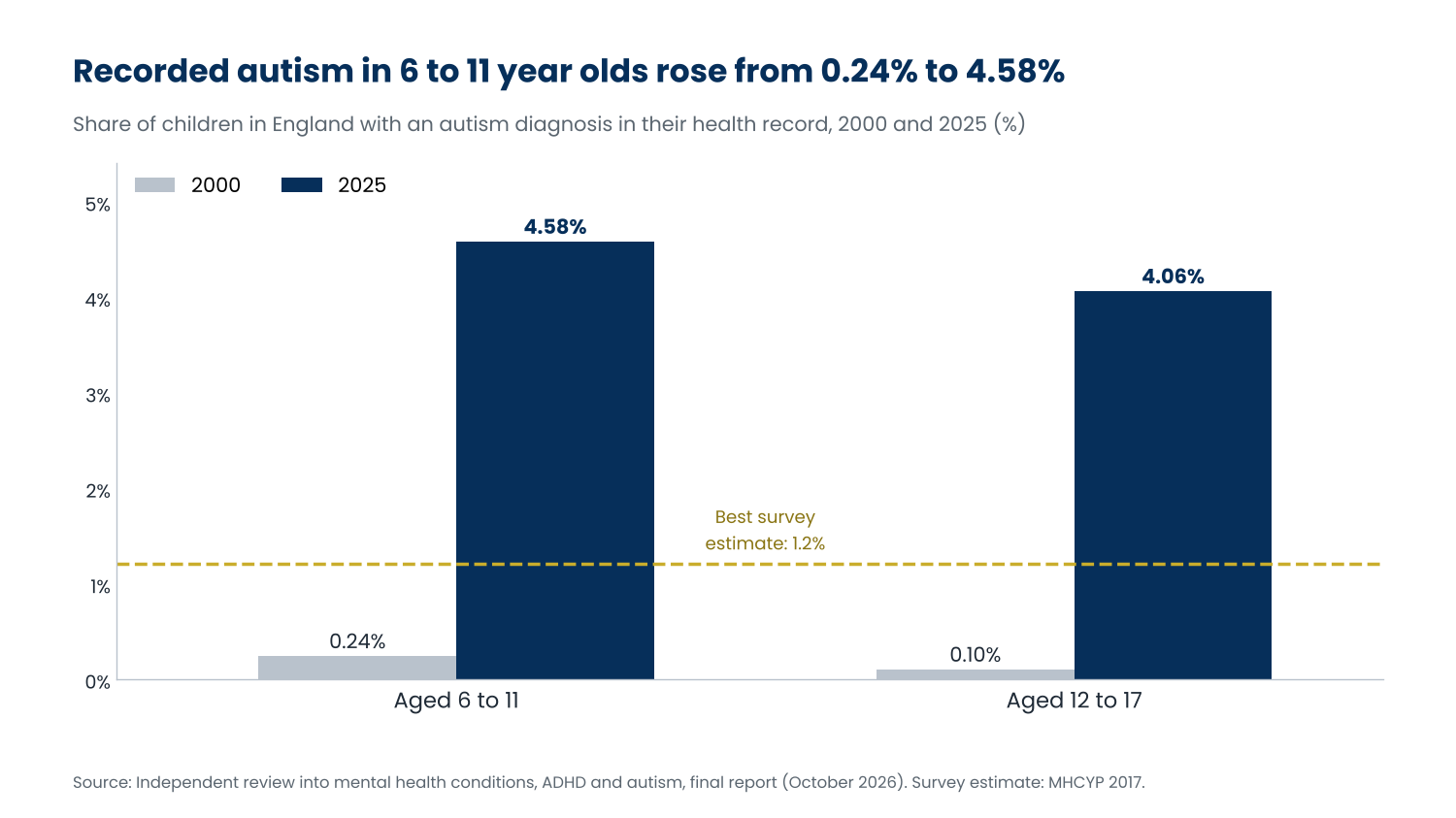
Recorded diagnoses in children have risen about twentyfold. Among 6 to 11 year olds in England, recorded autism went from 0.24% in 2000 to 4.58% in 2025. For 12 to 17 year olds it went from 0.10% to 4.06% (Independent review final report, October 2026).
Survey estimates of how common autism is have barely moved. The best available estimate remains about 1.2% of young people, from a 2017 survey, and around 1 in 100 adults in the 2007 and 2014 national surveys.
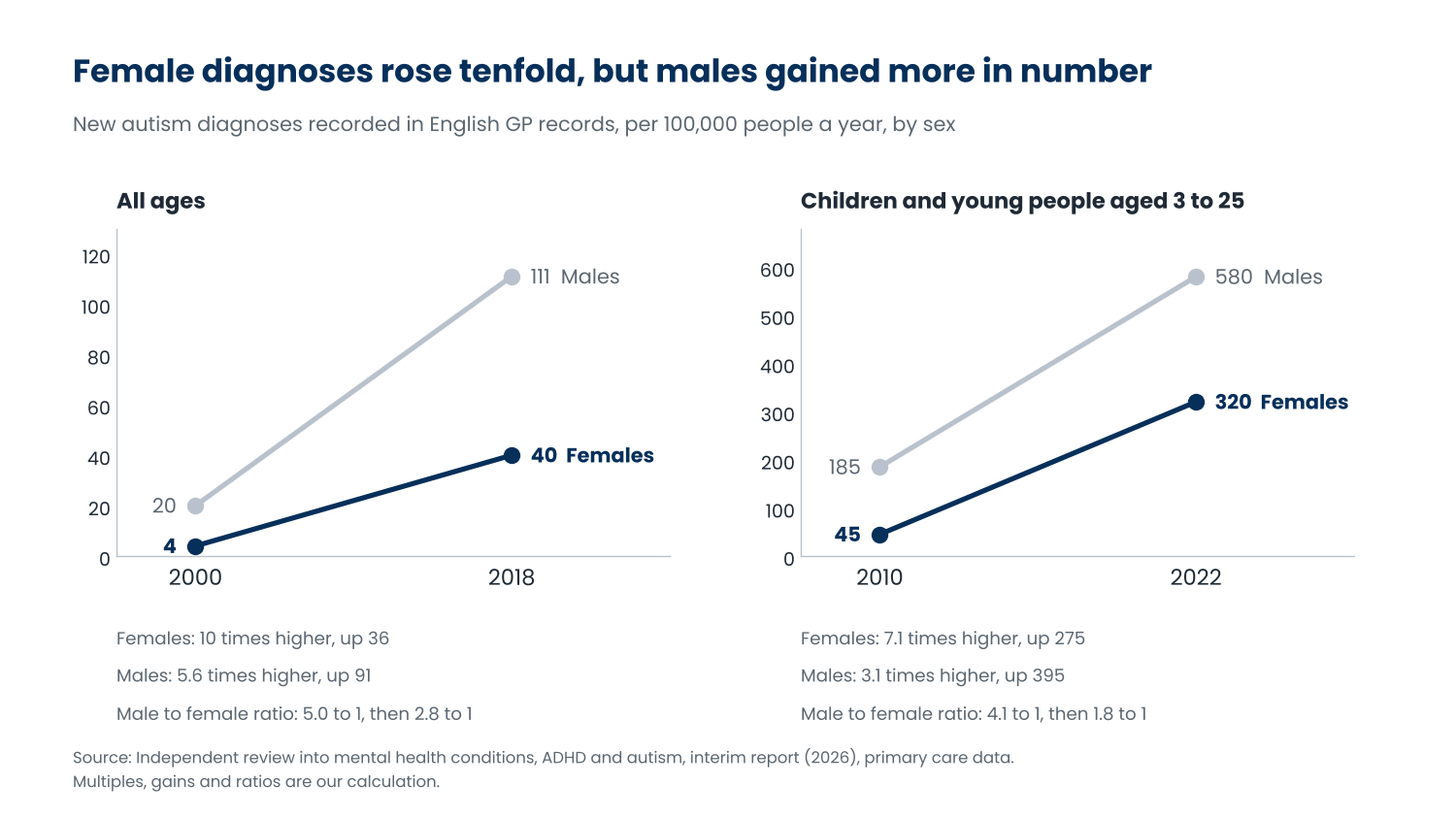
Female diagnoses are growing fastest in proportional terms. New diagnoses recorded by GPs in England rose tenfold in females of all ages between 2000 and 2018, from 4 to 40 per 100,000 a year, and about five and a half times in males, from 20 to 111 (Independent review interim report, June 2026). Males still gained more diagnoses in absolute terms. Among adults, the female rate has since overtaken the male rate: 10.2 against 6.7 per 10,000 a year in 2023 (BMJ Mental Health, November 2026).
The male to female ratio is shrinking. Among people aged 3 to 25, it fell from about 4 to 1 in 2010 to under 2 to 1 in 2022, on our calculation from the review's figures.
Wales shows the same pattern. New recorded diagnoses rose from 0.188 to 0.644 per 1,000 people a year between 2001 and 2016, with an eightfold rise among women (Underwood and colleagues, 2022).
Most autistic adults may still be undiagnosed. One estimate puts the number of undiagnosed autistic people aged 20 and over in England at about 750,000 (University College London, June 2023).
The demand for assessment reflects this. In June 2026 there were 294,792 people in England with an open referral for suspected autism, and 86.8% had been waiting at least 13 weeks, the longest wait that NICE recommends (NHS England, August 2026).
Why female diagnoses are rising fastest
Rates have risen for both sexes. Which sex is rising fastest depends on how you measure it, and these figures are easy to misread. Across all ages, new diagnoses rose tenfold in females between 2000 and 2018, from 4 to 40 per 100,000 a year. In males they rose about five and a half times, from 20 to 111, so males gained more in number: 91 more per 100,000 against 36 more for females.
Among people aged 3 to 25, the female rate rose from 45 to 320 per 100,000 a year between 2010 and 2022, a sevenfold rise, while the male rate tripled from 185 to 580. Here too the male rate gained more in number. The review prints the 2000 to 2018 figures under an adults heading and names no study. They match all-age figures from a University College London study of GP records, so we treat them as covering all ages.
Among adults, the female rate has now passed the male rate. A study of UK GP records for people aged 16 and over found that males had the higher rate of new diagnoses in 2010. By 2023 the rate was 10.2 per 10,000 a year in females against 6.7 in males (BMJ Mental Health, November 2026).
In the GP record study, 81.7% of people with an autism diagnosis in 1998 were male. By 2018 that had fallen to 77.5% (Irish Times, September 2021). The explanations offered by researchers are these.
Girls were being missed, and now fewer are. A review of 54 studies concluded that the true ratio among children is closer to 3 to 1 than the 4 to 1 usually quoted. Studies that screened whole populations found more girls than studies that relied on existing diagnoses (Loomes and colleagues, 2017).
Girls are catching up in their teens. In the Swedish study, boys outnumbered girls by about 3 to 1 before age 10. By age 20 the ratio was close to 1 to 1. The authors suggest the gap in childhood reflects when autism is recognised more than who is autistic.
Clinicians and referrers know more. The lead author of the English GP record study pointed to a deliberate drive to refer more females, and said the results suggest it has worked.
Adult services now exist. The Autism Act 2009 required every area in England to provide a route to adult assessment. Wales launched its Integrated Autism Service in 2016. Many women missed as children have come forward as adults, often after a child of their own is diagnosed.
Women recognise themselves in other women's accounts. Books, charities, broadcasters and social media have given autistic women a public voice that barely existed 20 years ago.
One finding from the most recent national survey is worth noting. In 2023/4, men and women in England were equally likely to say a professional had diagnosed them as autistic, at 1.2% of adults overall (NHS England, revised 2026).
Is autism increasing, or are we getting better at finding it?
This is the question most people ask, and the evidence points more strongly one way than the other. Most of the rise is in recognition and recording. A real increase in the number of autistic people cannot be ruled out, but there is little evidence for a large one.
It is not population growth. The population of England and Wales reached 61.8 million in mid-2024, up 7.6% in ten years (Office for National Statistics, July 2025). The diagnosis figures in this post are rates, expressed per 100,000 people or as a percentage, so they already allow for a larger population. A population that grows by a few per cent cannot explain a rate that grows twentyfold.
Surveys that assess people directly show little change. When researchers go into a sample of homes and assess people, whether or not they have a diagnosis, the answer has stayed close to 1 in 100: about 1.0% of children in 2004 and 1.2% in 2017, and about 1 in 100 adults in 2007 and 2014. The independent review concluded there is little evidence of a substantial change in underlying prevalence.
A caution is needed here. An adult figure for 2023/4 was published in November 2025 and then withdrawn in May 2026 after errors were found. NHS England says it should not be used, and no replacement estimate has been issued. The review's own recommendation is for regular national prevalence surveys, because England currently lacks up-to-date figures.
What has changed, then? The review and the research it draws on point to several things happening together.
Wider definitions. Each revision of the diagnostic manuals since 1980 has brought more people within the definition. In 2013, DSM-5 merged the separate subtypes into one spectrum and allowed autism and ADHD to be diagnosed together.
Awareness and reduced stigma. Parents, teachers and GPs recognise autism more readily, and adults are more willing to seek assessment.
Previously missed groups. Women and girls, adults, and people without a learning disability account for a large share of the growth. The Exeter team argued that there is no plausible reason for autism itself to rise faster in adults and females, so better identification is the likelier cause.
Diagnosis as a gateway. In schools and services, a diagnosis is often the practical route to support, which increases demand for one.
More assessment capacity. Independent providers now carry out more than a third of NHS-funded autism assessments.
Is autism now being overdiagnosed? The review's answer was careful. Its authors wrote that they "cannot conclude that overdiagnosis is occurring at scale", and noted that people now coming forward are no less impaired than those diagnosed earlier. They also warned that recorded diagnoses in some younger age groups now exceed survey estimates, and that the risk of misdiagnosis grows as numbers rise. Both things can be true: many autistic adults remain undiagnosed while some children in some areas may be diagnosed too readily.
How England and Wales compare with the rest of the world
International figures are hard to compare, because countries count in different ways and at different ages. With that caution, the pattern elsewhere is similar.
United States. About 1 in 31 eight year olds (3.2%) were identified as autistic in 2022, up from 1 in 150 in 2000. Boys were 3.4 times as likely to be identified as girls (Centers for Disease Control and Prevention, April 2025).
Sweden. Of 2.7 million people born from 1985 onwards, 2.8% had received an autism diagnosis.
Worldwide. The Global Burden of Disease study estimated that 61.8 million people, or 1 in 127, were autistic in 2021. The estimated rate in males was about twice that in females, a ratio of 2.1 to 1 (The Lancet Psychiatry, December 2024).
England and Wales. England's 2017 school census gave 1.76% of pupils, 2.81% of boys and 0.65% of girls (Roman-Urrestarazu and colleagues, 2021). Wales recorded 0.51% of people of all ages in 2016.
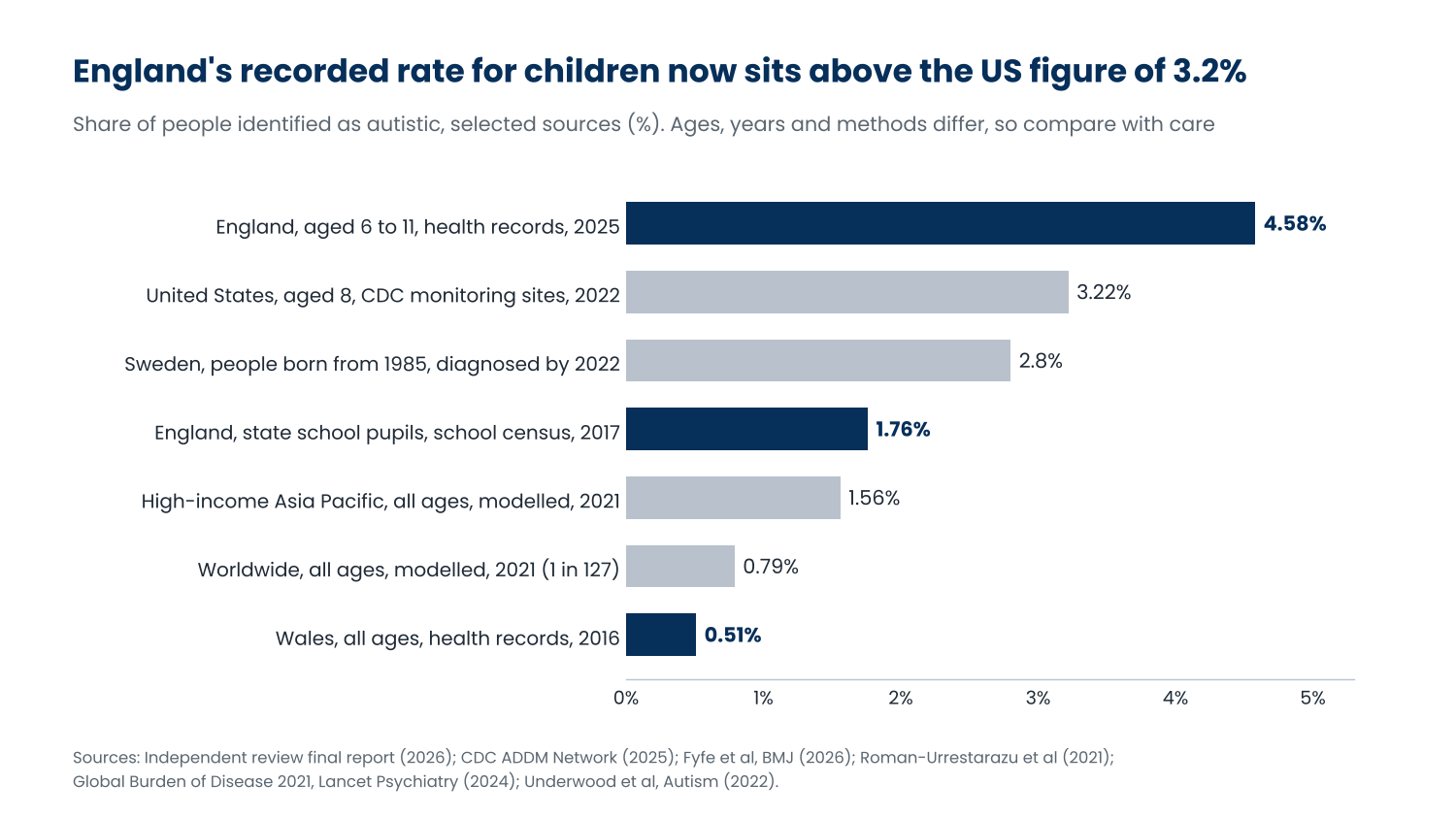
The independent review's reading is that rates across high-income countries are broadly similar in scale, and that the differences owe more to how each country looks for autism than to how many autistic people it has. The lower global ratio of about 2 to 1 comes from modelling that tries to correct for under-recognition of females.
If you think you or your child may be autistic
Do not rule it out because the picture does not match the stereotype. A girl who has a best friend, makes eye contact and does well at school can still be autistic. So can a boy who is quiet and compliant. What matters is the pattern over time and across settings, and the effort it takes to keep up.
Write down what you see. Useful notes include early development, friendships, reactions to change, sensory sensitivities, interests, and what happens after school or work. For a child, ask the school what they observe, and tell them what you see at home if it is different. For an adult, a parent or older relative who remembers your childhood can be valuable.
Ask about earlier diagnoses. If you or your daughter have been treated for anxiety, depression or an eating disorder and it has not fully explained things, it is reasonable to ask whether autism has been considered.
Know the routes. For children, start with the GP, health visitor or the school's special educational needs co-ordinator. For adults, start with the GP. NHS waits are long, and patients in England can ask their GP about Right to Choose, which allows referral to another NHS-funded provider. Some families choose a private assessment, and we have written about whether private assessments are accepted.
Support should not wait for a diagnosis. Schools are expected to respond to a child's needs whether or not there is a diagnosis. The independent review has recommended that services move to what it calls a needs-led plus diagnosis model, so that help begins while people wait.
Coming next: women, girls and masking
One explanation runs through almost every finding in this post. Many autistic girls and women learn, often without realising it, to hide their differences: copying how other people talk and dress, rehearsing conversations, forcing eye contact and suppressing the urge to move or withdraw. This is known as masking or camouflaging.
Masking helps to explain why girls are noticed later, why their difficulties are mistaken for anxiety or low mood, and why so many women reach adulthood exhausted and without an answer. It has a cost of its own. Our next post will look at autism, women and girls and masking in detail: what it is, how to recognise it, what it costs and how assessments can see past it.
The short version is this. Autism is defined in the same way for males and females, and the core experiences are shared. What differs is how visible it is, and girls and women have been harder for services to see. Diagnoses in England and Wales have risen steeply for both sexes since the late 1990s and fastest for females, while the best surveys suggest the underlying number of autistic people has changed little. Population growth does not explain the rise. Wider definitions, greater awareness and the recognition of people who were missed before explain most of it.
References
Official statistics and reviews
Department of Health and Social Care. Independent review into mental health conditions, ADHD and autism: executive summary of the final report. 9 October 2026.
Department of Health and Social Care. Independent review into mental health conditions, ADHD and autism: interim report. Updated 10 June 2026.
NHS England. Autism Statistics, July 2025 to June 2026. 13 August 2026.
NHS England. Adult Psychiatric Morbidity Survey 2023/4, chapter 10: autism spectrum disorder. Revised chapter, last edited 15 October 2026.
Office for National Statistics. Population estimates for England and Wales: mid-2024. 30 July 2025.
Centers for Disease Control and Prevention. Prevalence and early identification of autism spectrum disorder among children aged 4 and 8 years, United States, 2022. April 2025.
Research studies
Russell G and colleagues. Time trends in autism diagnosis over 20 years: a UK population-based cohort study. Journal of Child Psychology and Psychiatry, 2022.
Underwood J and colleagues. Evidence of increasing recorded diagnosis of autism spectrum disorders in Wales, UK: an e-cohort study. Autism, 2022.
O'Nions E and colleagues, reported by University College London. Number of autistic people in England may be twice as high as previously thought. 26 June 2023.
Loomes R, Hull L and Mandy W. What is the male-to-female ratio in autism spectrum disorder? A systematic review and meta-analysis. Journal of the American Academy of Child and Adolescent Psychiatry, 2017.
Fyfe C and colleagues, reported by BMJ Group. Time trends in the male to female ratio for autism incidence. The BMJ, 4 February 2026.
Roman-Urrestarazu A and colleagues. Association of race/ethnicity and social disadvantage with autism prevalence in 7 million school children in England. JAMA Pediatrics, 2021.
Global Burden of Disease Study 2021, reported by the Institute for Health Metrics and Evaluation. Autism spectrum disorder ranks among the top 10 causes of non-fatal health burden in youth. The Lancet Psychiatry, 19 December 2024.
Lotter V. Epidemiology of autistic conditions in young children: prevalence. Social Psychiatry, 1966.
Sadik A and colleagues. Changes in the profile of adults diagnosed as autistic since 2010: population-based studies in the UK and Sweden. BMJ Mental Health, 3 November 2026.
Charities
National Autistic Society. Autistic women and girls.
National Autistic Society. The history of autism.
News reports
Irish Times. Twentyfold jump in autism diagnoses in England over two decades. 27 September 2021.
All sources were checked on 15 November 2026. Male to female ratios for England are our own calculation from the rates published in the independent review's interim report.