

Author: Dominic Goodsell, Content Writer and Practice Manager Family Practice Group
If you are thinking about an autism assessment for yourself or your child, the first question is nearly always the same: how long are we going to be waiting?
For England, the short answer is "a long time, and it depends a great deal on where you live". At the end of June 2026 there were 294,792 people with an open referral for suspected autism, and 86.8% of them had already waited longer than the 13 weeks that NICE recommends (NHS England, August 2026). A year earlier, the national average wait was put at more than 17 months (National Autistic Society, August 2025).
Those two numbers hide a lot. The wait is different for children and adults. It can be a couple of months in one county and several years in the next. And the route many families have used to get seen sooner, Right to Choose, has changed a lot during 2026.
In this post we walk through what the published figures say, where they come from and what they leave out. Everything here covers the last five years (November 2021 to November 2026), every figure is linked to its source, and the full list of references is at the end.

The waiting time for an initial consultation with the Family Practice Group is less than 7 days.
The average waiting time for an assessment to begin is 4 weeks
The average waiting time from referral to final report is 9 weeks
What does "waiting time" actually mean?
Before the numbers, it helps to know what is being counted, because "the wait" can mean several different things.
The standard. NICE says that people referred to an autism team should have their diagnostic assessment started within three months of referral (NICE quality standard QS51). That is where the "13 weeks" you see quoted everywhere comes from. It is a recommendation, not a legal limit, and no service is penalised for missing it.
The data. NHS England publishes Autism Waiting Time Statistics every three months. They show how many people have an open referral, how many of those referrals are more than 13 weeks old, and the average number of days between referral and a first appointment. The "average" NHS England uses is the median: half of people waited less than this, half waited longer.
There are four things worth keeping in mind when you read these figures:
A first appointment is not a diagnosis. The clock in the statistics stops at the first care contact. The full assessment and the written report come later.
Many younger children are missing. Assessments carried out by community paediatric services are recorded in a different dataset and are not included yet. NHS England says it is working on this (NHS England, August 2026).
The average only counts people who were seen. It is worked out from people who had their first appointment in that quarter. Someone still waiting after three years does not appear in it until they are finally seen.
The figures move when providers miss a deadline. The June 2026 total fell by 5.1% in a month, from 310,794 to 294,792, mainly because one large provider, the Owl Centre, did not send its data in time. Its 22,900 open referrals simply dropped out of the count.
NHS England still labels these as "official statistics in development". They are the best national picture we have, but they are a floor, not a ceiling.
The national picture: more people waiting, for longer
Two things have happened at once over the last five years. The queue has grown, and the time people spend in it has grown too.
Start with the queue. In December 2022 there were 117,020 people with an open referral for suspected autism (PA, reported in the Press and Journal). By December 2024 that had reached 212,964 (National Autistic Society, February 2025). By June 2026 it was 294,792 (NHS England, August 2026). That is two and a half times as many people in three and a half years.
The reason is simple arithmetic. In June 2026 there were 17,509 new referrals and 13,492 closed ones. Around 4,000 more people joined the list than left it, in a single month.
Now the wait itself.
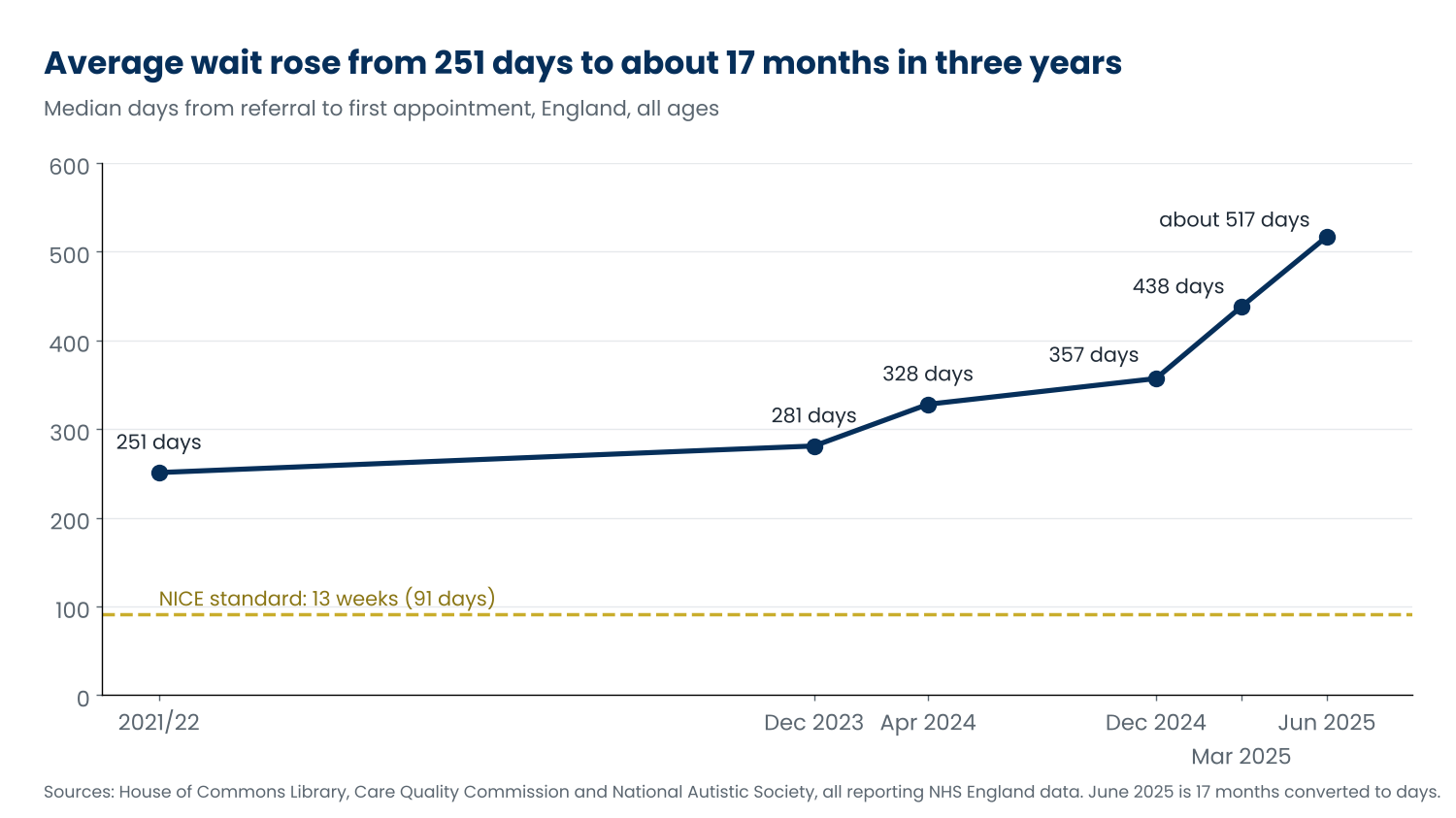
The points on the chart come from the House of Commons Library (2023), the House of Commons Library (2024), the Care Quality Commission, the House of Commons Library (2025), the National Autistic Society as reported by Mancunian Matters, and the National Autistic Society (August 2025).
The headline summary for June 2026 does not quote a single national average. What it does say is that only 3.8% of people whose referral was more than 13 weeks old had been given a first appointment inside the 13 weeks. The National Autistic Society adds that the average wait is now as high as three years in some areas (National Autistic Society, August 2026).
Why is this happening? The charity is clear that more referrals do not mean more autism. More people are coming forward because autism is better understood, particularly in women and girls who were missed in the past. The difficulty is that the number of assessments the NHS can carry out has not grown to match.
Children and adults: who waits longer?
Nationally, children and young people tend to wait longer than adults, although the gap changes from place to place.
The Care Quality Commission looked at this in its annual State of Care report. In April 2024 the average wait to start an assessment was 356 days for children and young people, compared with 238 days for adults (CQC, State of Care 2023/24). By June 2025, under-18s in England were waiting more than 18 months on average, against 17 months for all ages (PA analysis of NHS England data, August 2025).
Researchers at the Child of the North partnership found that in March 2025 only 4.5% of people with an open autism referral had been given an appointment within the recommended 13 weeks (Child of the North, 2025).
It does not always run the same way locally. In Somerset in June 2025, under-18s waited two years and four months on average, while the all-age figure was 20 months. In Cornwall it was the other way round: 17 months for under-18s and 22 months overall (West Somerset Free Press; The Post, both August 2025).
Remember, too, that the children's figures are incomplete. Many younger children are assessed by community paediatricians, and those waits are not in the national statistics at all.
For adults, the wait often starts before the referral. The National Autistic Society shared the story of Gavin, who sought an assessment in his 40s after his son was diagnosed. He needed three attempts before his GP referred him, and then waited about three years for his diagnosis (National Autistic Society, August 2026). He describes the diagnosis as life-changing, which is a useful reminder of why the length of the queue matters so much.
Where you live matters more than anything else
This is the part of the data that surprises people most. Two families referred on the same day can face completely different waits, simply because they live in different places.
A quick word on geography first. Autism assessments are planned and paid for by Integrated Care Boards (ICBs), and carried out by NHS trusts and other providers working for them. NHS England publishes its figures by region, ICB, smaller sub-ICB area and individual provider. Almost all public reporting is at ICB level, so that is what we use here. If you want the figure for a particular trust, you can look it up in NHS England's interactive dashboard. Bear in mind that on 1 April 2026 England's 42 ICBs became 36 through mergers, so figures from before that date use the old names.
The fullest recent set of local averages we could find in published reporting is for June 2025.
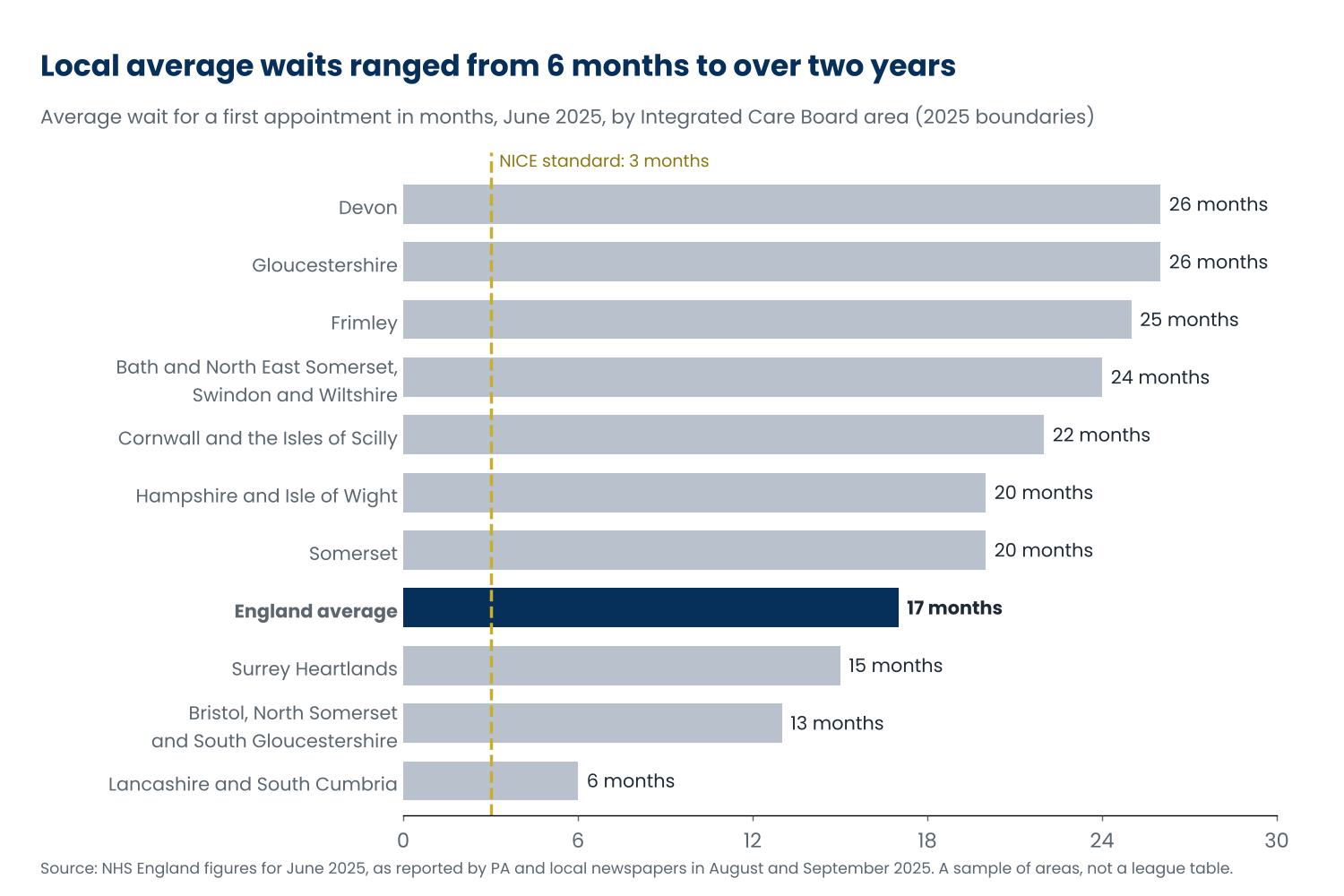
These ten areas are the ones where local figures were reported in the press, mostly in the South West and South East, so treat this as a sample and not a league table. The figures come from local reports for Devon, Gloucestershire, Frimley, Bath and North East Somerset, Swindon and Wiltshire, Cornwall, Hampshire and Isle of Wight, Somerset, Surrey Heartlands, Bristol, North Somerset and South Gloucestershire and Lancashire and South Cumbria.
Look further afield and the gap gets wider still:
In March 2025 the average wait was 54 days in Mid and South Essex and 1,063 days in South Yorkshire. That is a difference of almost three years (Child of the North, 2025).
In December 2024 the average in Dorset was 62 days, while the average for the South West region as a whole was 548 days (written parliamentary answer, 2025).
Asked under Freedom of Information for its average wait from referral to assessment in 2025/26, Derby and Derbyshire ICB gave a figure of 2,321 days, which is 6.4 years (Neurodiversity Directory, 2026).
Two cautions before you read too much into any single local number.
First, a short average is not always good news. The average only counts people who were seen, so an area that sees a small number of recent referrals quickly, while others wait, can look better than it feels. Hampshire and Isle of Wight's average went from three months to 20 months in a single year, which says as much about recording as it does about the service.
Second, local totals depend on which providers send in data. In June 2025 Devon recorded 11,835 people waiting, while Bath and North East Somerset, Swindon and Wiltshire recorded only 360. Hampshire and Somerset have both said their own waiting-list figures leave out people referred through Right to Choose (Neurodiversity Directory, 2026).
The safest thing is to ask your local service directly what its current wait is.
Right to Choose: the faster route that is slowing down
What it is. In England, if your GP agrees to refer you for an autism assessment, you can usually ask to be referred to any suitable provider that holds an NHS contract for that service, instead of your local team. The NHS still pays. The right comes from the NHS choice rules (regulation 39 of the NHS Standing Rules) and applies in England only.
Can the official figures be split by route? Not cleanly, and it is better to say so plainly. NHS England's statistics count referrals from every provider that sends in data, and that includes independent Right to Choose providers. Two of them, the Owl Centre and Psychiatry UK, are named in NHS England's own data notes, with 22,900 and 14,125 open referrals respectively (NHS England, August 2026; NHS England, May 2026). So the national average blends both routes, and there is no published national average for each one.
What we can do is compare the local averages above with the waits that Right to Choose providers publish themselves, where no local limit applies:
Psicon: adults 4 weeks; children 12 weeks.
Problem Shared: 10 to 12 weeks.
Psychiatry UK: adults up to 18 to 20 weeks.
Evolve Psychology: adults 14 to 28 weeks; children 12 to 18 months.
The Owl Centre: 26 to 34 weeks in several areas.
Clinical Partners: adults about 12 to 18 months.
These were checked on 11 November 2026. They are the providers' own estimates, and several are counted from the day they receive your completed forms, not the day your GP refers you.
Set against a national average of 17 months, most of these are much shorter. One ICB has put a number on it: Hampshire and Isle of Wight says Right to Choose patients make up around 27% of everyone waiting in its area and have usually waited a good deal less than people on local lists (Finally Seen briefing, September 2026).
What changed in 2026. As more people used Right to Choose, the bill grew. Freedom of Information replies show ICB spending with private ADHD and autism providers more than doubled between 2023/24 and 2024/25, and came to at least £523 million across three years (Neurodiversity Directory, 2026).
For 2026/27, many ICBs responded by agreeing a fixed number of assessments with each provider for the year. Once a provider has used up that number, it can still accept your referral, but it cannot assess you until more funding is agreed.
By 23 September 2026, 15 of England's 36 ICBs were capping, pausing or slowing Right to Choose assessments for ADHD or autism. Four had published a minimum wait: two years in West Yorkshire, about 78 weeks in the North East and North Cumbria, 52 weeks for adults in Somerset, and at least 14 weeks (up to 52) in Devon. Kent and Medway has told people that routine referrals are unlikely to be seen before April 2027 (Finally Seen briefing, September 2026).
You can see the effect in the waits one large provider now quotes for each part of the country.
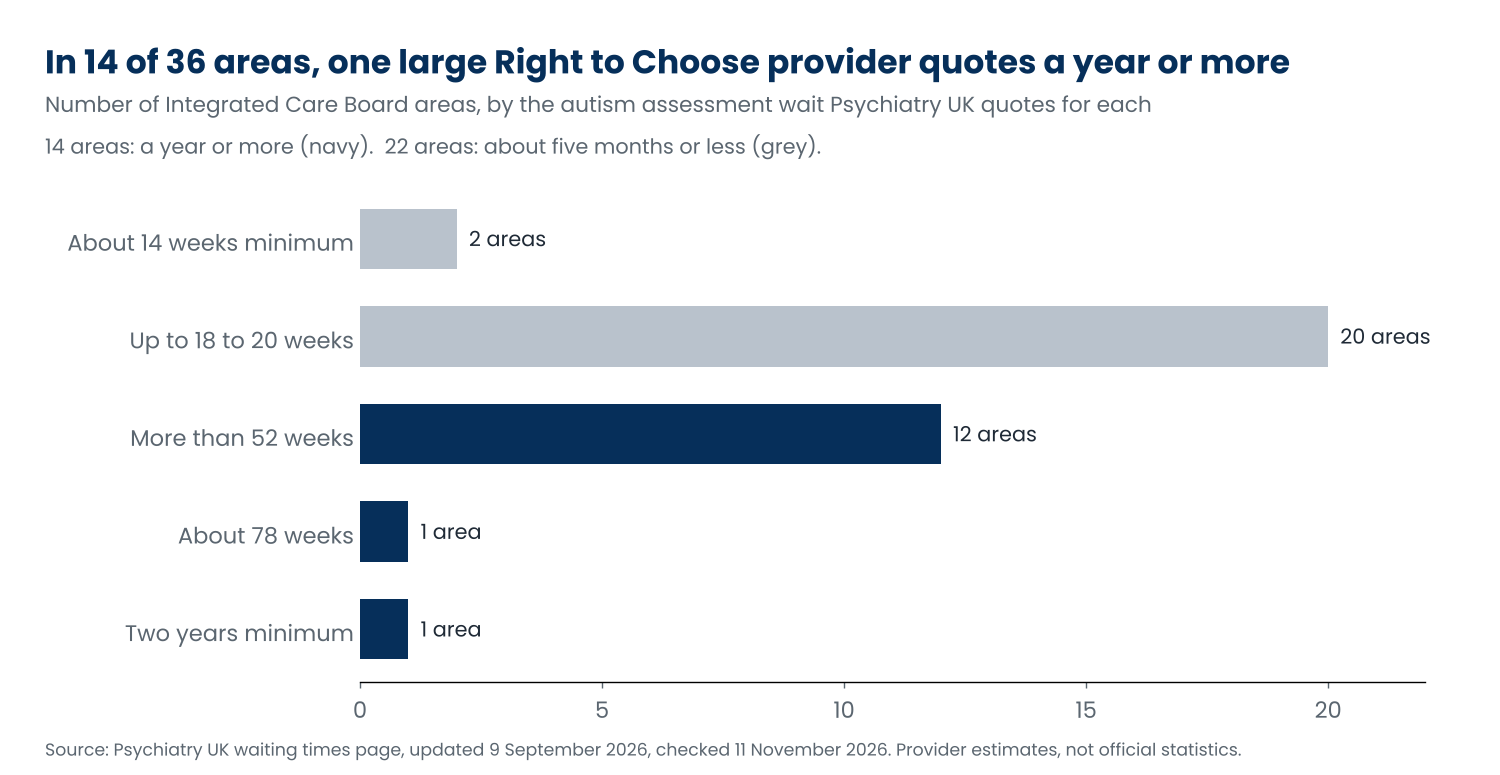
The areas quoting more than 52 weeks include Greater Manchester, Kent and Medway, Thames Valley, Birmingham and Solihull, and Hampshire and Isle of Wight. Where there is no local limit, the same provider quotes about four to five months.
The legal right itself has not gone away. In a written answer in April 2026, the government said these activity plans must not restrict a patient's choice of provider. In practice, though, in a capped area your referral is accepted and you then join a queue with no date. The National Autistic Society describes the result as a postcode lottery (National Autistic Society, August 2026).
So the picture for Right to Choose in late 2026 is mixed. In many areas it is still far quicker than the local NHS average. In others, the wait is now a year or more, which is not very different from the local list.
What this means if you are deciding what to do
None of this is meant to put you off. It is meant to help you plan. A few practical points follow from the data.
Get the referral in. Every measure of waiting starts from the referral date. If you are fairly sure you want an assessment, waiting to ask only adds to the total.
Ask your local service two questions. What is the current wait, and what does that figure measure: the first appointment, or the finished assessment and report? As we saw above, those can be very different things.
Check Right to Choose for your own area before you pick a provider. Find out which Integrated Care Board your GP practice sits in, then look at that area's entry on two or three providers' waiting-time pages. The same provider can quote four months in one county and two years in the next.
Keep a note of dates. Write down when the referral was made, who it went to and anything you are told about timescales. It makes chasing much easier.
Ask for support now. Help at school or at work is supposed to be based on need, not on a diagnosis. The National Autistic Society has a helpful guide on what you can do while waiting for an assessment.
If you look at a private assessment, check how it is done. What matters is that it is carried out by trained, experienced, properly registered clinicians and follows NICE guidelines. We cover this in more detail in our post on whether private autism assessments are accepted.
The short version is this. The national standard is three months. The national average is well over a year. And your own wait will depend mostly on your postcode, your age and which route your referral takes. Knowing that at the start will not shorten the queue, but it does let you choose your route with your eyes open.
Update, 13 November 2026. NHS England published its July to September 2026 figures on 12 November. They show 336,764 people waiting at the end of September, 34% more than a year earlier, with 87% waiting longer than 13 weeks. In some areas the average wait is now three years and seven months (National Autistic Society, November 2026).
References
All sources were checked on 11 November 2026.
Official statistics and standards
NHS England (13 August 2026). Autism Statistics, July 2025 to June 2026.
NHS England (14 May 2026). Autism Statistics, April 2025 to March 2026.
NHS England. Autism waiting times: referral to care contact dashboard.
National Institute for Health and Care Excellence (2014). Autism: quality standard QS51, quality statement 1.
UK Parliament (2025). Written question 42843: Autism and Special Educational Needs, South West.
Care Quality Commission (2024). The state of health care and adult social care in England 2023/24.
Parliamentary research
House of Commons Library (2023). Debate pack CDP-2023-0023: assessments for autism and ADHD.
House of Commons Library (2024). Autism: overview of policy and services, CBP-7172.
House of Commons Library (2025). Autism policy and services: health and social care, CBP-10232.
Charities and research groups
National Autistic Society (13 August 2026). Autism assessment waiting times: over 294,000 face waits. Includes Gavin's story.
National Autistic Society (14 August 2025). Autism assessment waiting times: over 236,000 face waits.
National Autistic Society (13 February 2025). Autism assessment waiting times: over 212,000 face waits.
National Autistic Society. What can I do while waiting for an autism assessment?
Child of the North (2025). Autism assessment and support update: the crisis is worsening. N8 Research Partnership.
Finally Seen (23 September 2026). Which ICBs are rationing ADHD and autism assessments? Source for ICB statements, published minimum waits and the April 2026 written answer.
The Neurodiversity Directory (updated 4 November 2026). NHS private spending on ADHD and autism by ICB. Freedom of Information analysis.
News reports of NHS England figures
PA, in the Press and Journal (2024). Autism assessment waiting list figures for December 2023.
Mancunian Matters (23 May 2025). Proportion of autism patients receiving first appointments has declined three years in a row.
Local reports of June 2025 figures, published 20 August 2025: Petersfield Post (Hampshire and Isle of Wight, and England); Crediton Courier (Devon); The Forester (Gloucestershire); Haslemere Herald (Frimley); Midsomer Norton, Radstock and District Journal (Bath and North East Somerset, Swindon and Wiltshire) and again (Bristol, North Somerset and South Gloucestershire); The Post (Cornwall); West Somerset Free Press (Somerset); Farnham Herald (Surrey Heartlands).
Lancashire Evening Post (6 September 2025). Suspected autism patients have six months' average wait to be seen.
Right to Choose provider waiting-time pages
Psychiatry UK. Initial assessment and titration waiting times (updated 9 September 2026).
Psicon. Right to Choose: waiting times.
Problem Shared. NHS Right to Choose ADHD and autism assessments (as of 1 October 2026).
Evolve Psychology. Right to Choose waiting times.
The Owl Centre. Right to Choose waiting times.
Clinical Partners. Wait times for Right to Choose adult autism assessments.