
Author: Dominic Goodsell, Content Writer and Practice Manager Family Practice Group
You can get a combined autism and ADHD assessment on the NHS in England, but only in some areas, and rarely through Right to Choose. Most people who need both are assessed twice, on two waiting lists. About 336,000 people were waiting for an autism assessment at the end of September 2026 (our waiting-times post, November 2026), and NHS England counted up to 803,658 open referrals that may be for an ADHD assessment in March 2026 (NHS England, May 2026).
We wrote this on 24 November 2026. We are a private practice, we offer a combined assessment and we do not accept Right to Choose referrals, so weigh our view with that in mind. Right to Choose is free, and it is a good route for many families.
The key points
Having one often means having both. Between a quarter and two fifths of autistic people also have ADHD. About 1 in 5 children with ADHD are also autistic.
ADHD can hide autism for years. Studies find children with ADHD are diagnosed autistic between about 8 months and 3 years later.
Checking for one condition can lead to the wrong answer. The national review (October 2026) says looking at only one makes a wrong diagnosis more likely.
Right to Choose means two queues. You fill in two sets of forms and wait twice. Only one of six big providers we looked at offers both together, and only for children.
Where you live changes what you get. In one UK survey, only 8% of children's autism clinicians who answered worked in a service that assesses both together.
Free assessments are getting harder to get. In September 2026, 15 of England's 36 local NHS areas, known as Integrated Care Boards (ICBs), were limiting, pausing or slowing Right to Choose assessments.
Why assess for autism and ADHD together?
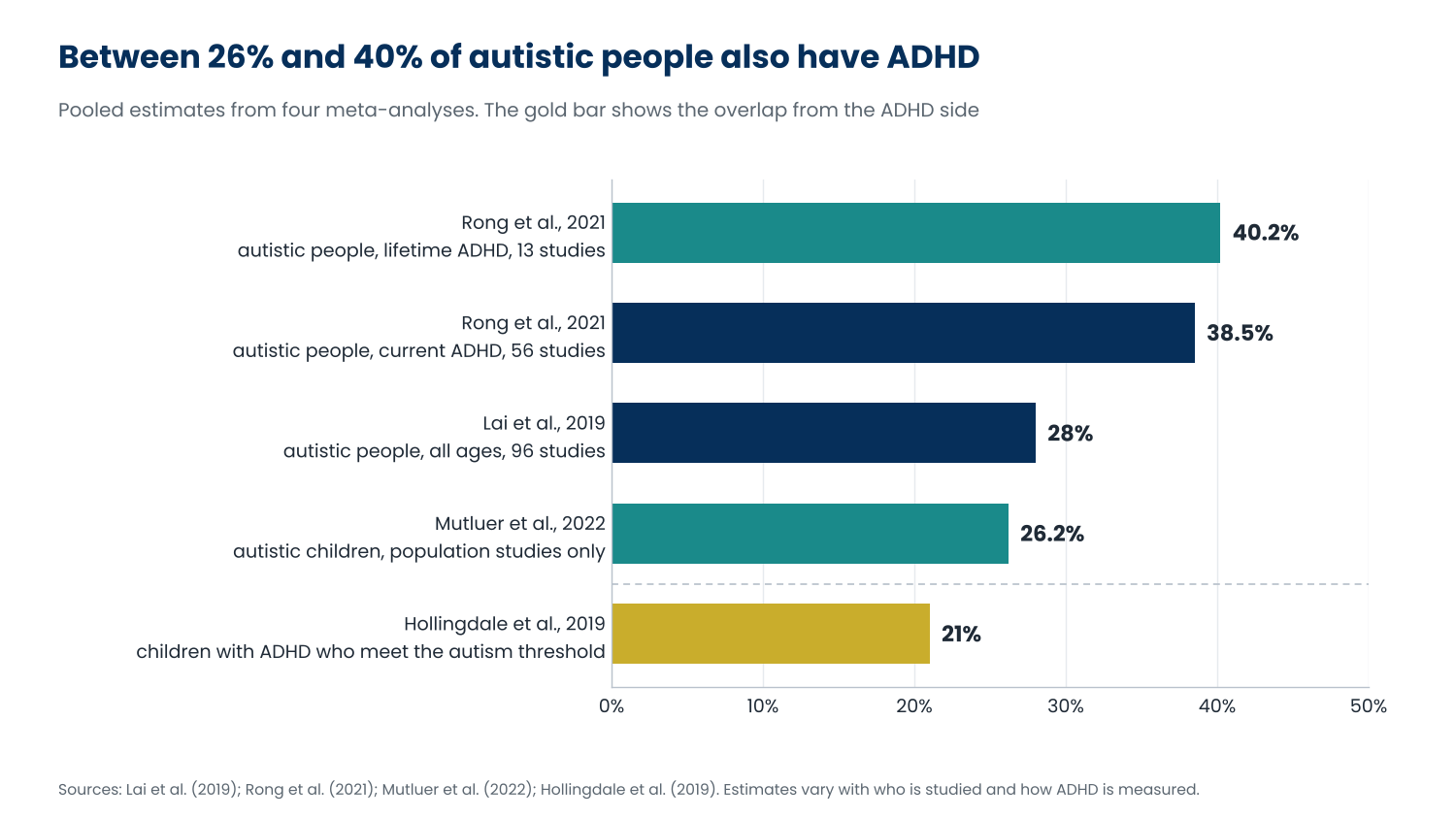
The overlap is large. A meta-analysis of 96 studies found ADHD in 28% of autistic people (Lai et al., 2019). A later one put current ADHD at 38.5% and lifetime ADHD at 40.2% (Rong et al., 2021). Studies of children drawn from the general population give 26.2% (Mutluer et al., 2022). From the other side, a meta-analysis of 22 publications found that 21% of children with ADHD met the threshold for autism (Hollingdale et al., 2019).
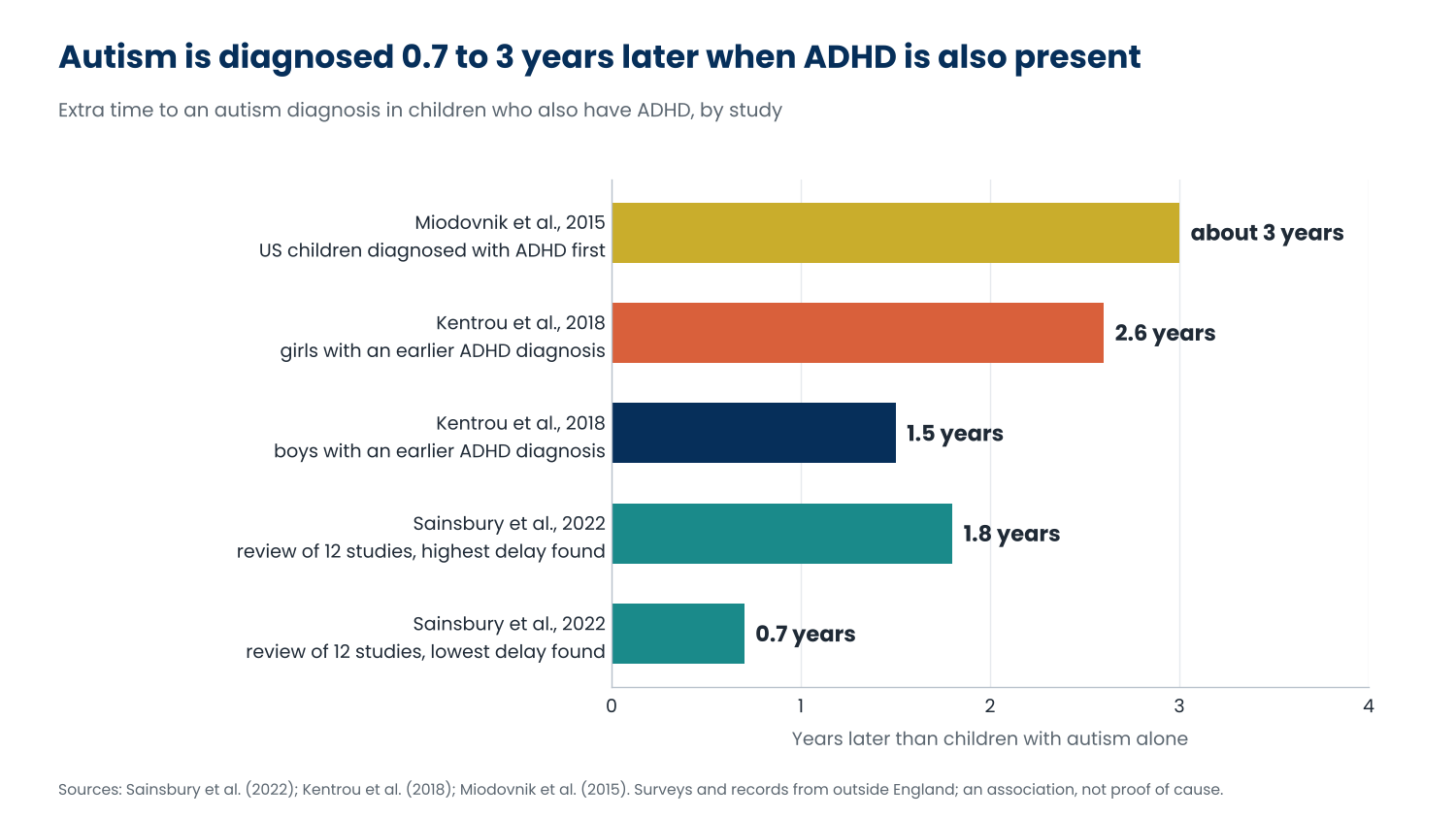
ADHD delays the autism diagnosis. A systematic review of 12 studies found autism diagnosed 0.7 to 1.8 years later in children who also had ADHD (Sainsbury et al., 2022). In a US parent survey of 1,496 autistic children, those diagnosed with ADHD first received their autism diagnosis about three years later (Miodovnik et al., 2015). A second survey found a delay of 1.5 years for boys and 2.6 years for girls (Kentrou et al., 2018).
Guidance tells clinicians to look for both. NICE lists autistic people among the groups more likely to have ADHD and says an ADHD assessment must cover coexisting conditions (NICE NG87, updated September 2019). A UK expert consensus says both conditions should be considered whenever one is present, and that no single instrument should decide a diagnosis (Young et al., 2020).
The government's independent review, chaired by Professor Peter Fonagy, goes further. It calls co-occurrence "the rule rather than the exception" and recommends integrated assessment to cut misdiagnosis (Department of Health and Social Care, October 2026).
Where these figures can mislead
Prevalence depends on who is counted. One review of autistic young people found ADHD symptom rates from 2.6% to 95.5%, because studies measured ADHD so differently (Eaton et al., 2023). Clinic samples give higher figures than population samples. Before 2013 the diagnostic manual did not allow both diagnoses together, so older studies undercount.
The delay studies show association, not cause. Most rely on parents' recall and none comes from England. One study in the Sainsbury review found that adjusting for sex, ethnicity and maternal education cut a one-year delay to one month.
Proof that combined assessment works better is thin. In 408 assessments across 30 Scottish teams, 21% of children and 15% of adults received more than one diagnosis, but teams took part voluntarily (Maciver et al., 2025). A Buckinghamshire NHS service redesigned its pathway and raised completed assessments from 147 to 391 over matching six-month periods, with no child returning for a second assessment (Bhogal et al., 2026). That is one service's before-and-after count, not a trial.
Our provider and trust examples are examples. No national list shows which services offer combined assessment. We read websites and Freedom of Information replies. That is not a survey.
What a combined assessment gives you that two separate ones do not
A combined assessment is one process. The same clinical team takes one developmental history, uses the standard tools for both conditions and weighs the evidence together.
Overlapping traits are attributed properly. Poor attention, social difficulty, emotional outbursts and sensory seeking can come from either condition.
You tell your story once. One set of questionnaires and one history, not two.
One report. Recommendations for school, work and home that account for both conditions.
A clear negative. If both were assessed, "autism but not ADHD" is a finding, not a gap.
Can you get a combined autism and ADHD assessment through Right to Choose?
You can be referred for both, but usually as two assessments. Right to Choose is the legal right in England to pick your provider when a GP refers you for a first outpatient appointment, if that provider holds an NHS contract for the service (Department of Health and Social Care, updated October 2024). Autism and ADHD assessments are contracted separately, so the offer depends on the contracts a provider holds.
We read six large providers' Right to Choose pages between 16 and 24 November 2026.
Psicon and Clinical Partners assess adults and children for both conditions, with a separate waiting time for each.
ProblemShared, Psychiatry UK and RTN assess adults for both and children for autism only. ProblemShared asks anyone seeking both to complete two forms.
Evolve Psychology offers combined assessments for ages 6 to 19 on Right to Choose. For adults its contract covers autism only, and combined adult assessments are private.
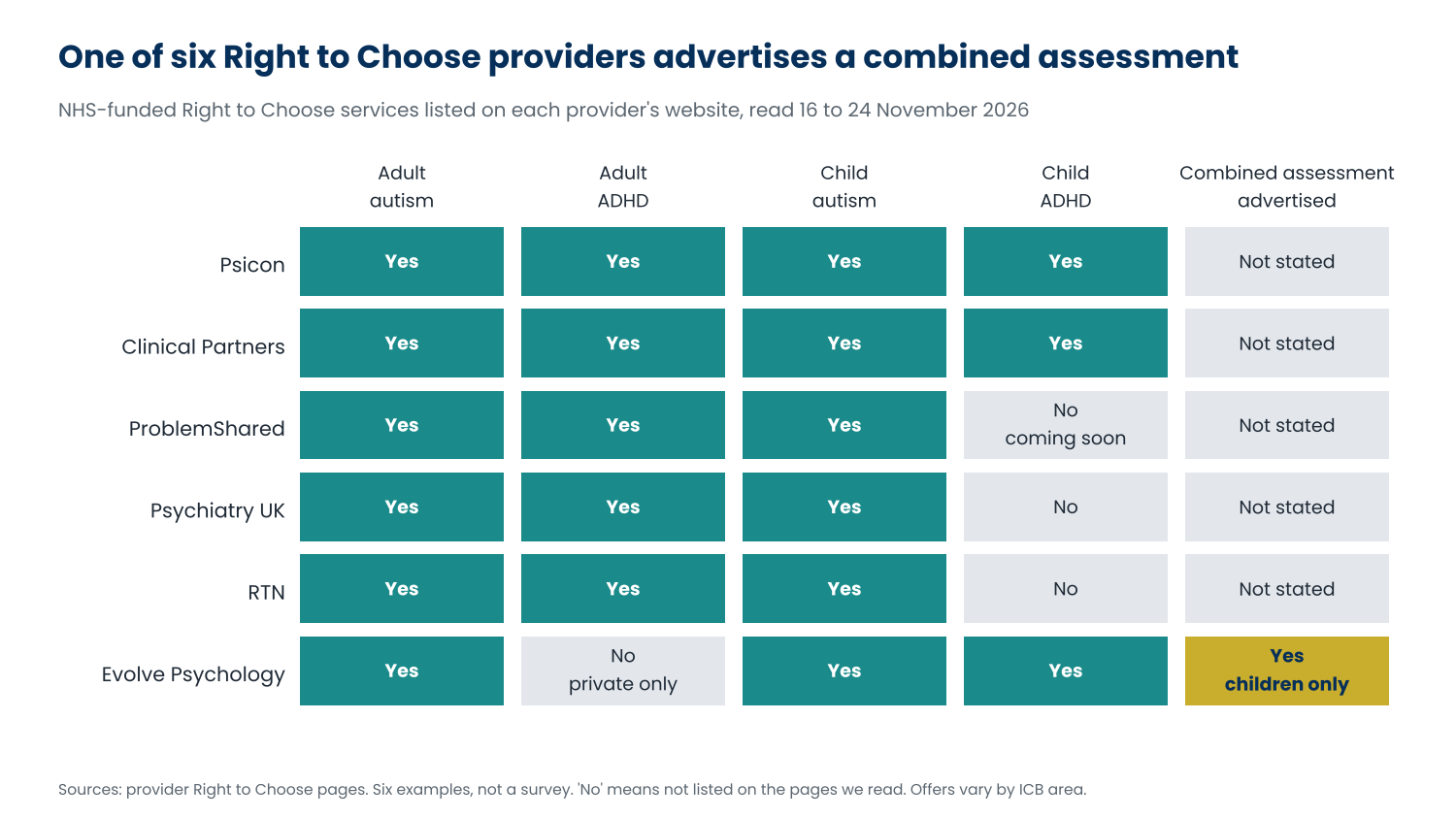
The Owl Centre asks for both sets of forms when someone needs both. Other providers may still assess one person for both conditions. Ask before you assume.
The wait is the second problem. Where an ICB has set no limit, providers quote short waits: 4 to 12 weeks at ProblemShared and 2 to 5 weeks at Clinical Partners. But 15 of 36 ICBs were restricting activity by September 2026 (Finally Seen, September 2026). West Yorkshire sets a two-year minimum with independent providers (NHS West Yorkshire ICB, 2026) and the North East and North Cumbria works to about 78 weeks (NHS North East and North Cumbria ICB, 2026). Evolve quotes 12 to 18 months for children (Evolve Psychology, November 2026).
Do NHS trusts offer combined autism and ADHD assessments?
A minority do. No national rule requires it, and each ICB decides how its services are organised. In a UK survey of 128 clinicians in children's autism assessment services, 10 (8%) worked in integrated services, and many teams could not assess for associated neurodevelopmental conditions (Parr et al., 2024). Respondents volunteered, so treat 8% as a guide.
A combined list. Gloucestershire's children's service keeps three lists: autism, ADHD and "combined assessment need". In February 2026 the combined list held 1,668 children, against 1,070 for autism and 515 for ADHD. Its adult lists are separate (Gloucestershire Health and Care NHS Foundation Trust, February 2026).
One service, two queues. Nottinghamshire merged its adult autism and ADHD services. In September 2026 it was seeing autism referrals from July 2021 and ADHD referrals from December 2021 (Nottinghamshire Healthcare, September 2026).
Combined where possible. Coventry and Warwickshire has allowed referral for a combined assessment since May 2026, but says not every provider can offer one yet (NHS Coventry and Warwickshire ICB, 2026).
Know two rules. You can hold one autism referral and one ADHD referral at once, but not two for the same condition (NHS North East and North Cumbria ICB, 2026). Choosing a Right to Choose provider normally closes your local referral for that condition, and returning later can mean starting again (South London and Maudsley NHS Foundation Trust, 2026).
Is Right to Choose the right route for you?
For many families, yes. It costs nothing and in an uncapped area it is fast. Two national reports explain why it is not always the best clinical option.
The Fonagy review found that independent providers carry out more than half of NHS-funded ADHD assessments and more than a third of autism assessments. It said it was seriously concerned about the consistency and quality of independent-provider ADHD assessments, but said this was no criticism of independent provision in principle. It recommends that every ADHD and autism diagnostic assessment becomes an activity regulated by the Care Quality Commission (Department of Health and Social Care, October 2026).
The Health Ombudsman reached the same point from complaints, which rose from 410 to 1,257 in five years. Providers that only assess NHS-funded patients are not registered with the Care Quality Commission (Parliamentary and Health Service Ombudsman, August 2026).
These findings concern NHS-funded work as a whole, not every provider, and many providers assess well. The Ombudsman covers NHS-funded providers. It does not cover self-funded practices such as ours, but private practices receive complaints too.
The review names what raises the risk of misdiagnosis: assessments that are brief, not face to face, fragmented, made without informants or records, or focused on one condition. Hold any provider to that list, including us.
Our view, and what we do differently. At least three clinicians contribute to every assessment. Every autism assessment includes both the ADI-R interview and the ADOS observation, and our online observation is ADOS-informed. We use that label because the ADOS was not designed or validated for online use, and few remote autism assessment tools have been validated (Corona et al., 2024). In our experience, many NHS trusts and local authorities accept it. Katherine Goodsell leads every assessment. No NHS guide price or volume contract sets our fees or our time.
Children and adults
Children. Children's ADHD is the service least often offered on Right to Choose. Three of the six providers do not assess under-18s for ADHD, so a family may find one provider for autism and wait elsewhere for ADHD.
Adults. Most large providers assess adults for both, on two pathways. A combined assessment needs only one developmental history from someone who knew you as a child, which matters when parents are elderly.
What it costs
Right to Choose is free to you. Several ADHD providers also start medication, with a separate queue: ProblemShared quotes 25 to 40 weeks and Clinical Partners about six months.
A private combined assessment costs money but saves time. Our combined assessment costs £1,995 for under-19s and £1,895 for adults, plus a £195 initial consultation. Our autism-only assessment costs £1,595 and £1,495, so adding ADHD adds £400. Fees elsewhere vary.
People pay for a combined assessment for four reasons:
Their area is capped. A free assessment in two years does not help a child starting secondary school next September.
They would need two referrals. Two queues and two reports, with nobody joining the findings.
The picture is mixed. Assessing one condition risks half an answer and a second wait.
The service is not offered. Children's ADHD and adult combined assessments are the main gaps.
Going private has drawbacks. Psychologists cannot prescribe. If ADHD is diagnosed and you want medication, we refer you to a partner prescribing clinic, which is registered with the Care Quality Commission in England. Our partner clinics accept our reports, so you will not need a second assessment, but treatment has its own fees, which each clinic sets and you pay to the clinic directly (see ADHD treatment after your assessment). Some GPs will not take over prescribing from every provider (South London and Maudsley NHS Foundation Trust, 2026). If your GP declines, our partner clinics can usually continue prescribing privately. Check that the report will be accepted where you need it: we cover whether private autism assessments are accepted separately.
When one assessment is enough
Most autistic people do not have ADHD, and about four in five children with ADHD are not autistic. If the traits sit clearly on one side, choose a single assessment. Consider a combined one when questionnaires, school feedback or your own experience point to both, or when an earlier diagnosis never explained everything.
Not sure which applies? That is what our initial consultation is for. For £195, we use a licensed screening tool, and an experienced clinical psychologist spends an hour with you working out whether to assess for autism, ADHD or both. See our combined autism and ADHD assessment for fees.
Practical advice for families and adults
Ask your GP to refer you for both. Your wait starts from the referral date, whichever route you take.
Ask any provider five questions. Do you check both for my age? Is it one assessment or two? One report or two? How long is the wait where I live? Who prescribes ADHD medicine if I need it?
Check the wait in your area first. One provider can offer weeks in one area and nothing this year in another.
Know what you give up. Choosing Right to Choose usually takes you off your local NHS waiting list.
Check the provider does it properly. Look for face-to-face meetings where possible, input from people who know you, your records, enough time, and checks for both conditions.
Ask for help now. Support at school or work should be based on need. You do not need a diagnosis first.
The short version is this. Autism and ADHD often come together, and one can hide the other. If you think both apply, get checked for both at once. Only some NHS areas do this. Right to Choose pays for both, but as two separate assessments, and waits are growing in many areas. A private combined assessment gives you one process and one answer. It costs money, and we cannot prescribe. Where you live, your age and how long you can wait will decide your best route.
References
Official statistics and standards
NHS England (May 2026). ADHD Management Information, May 2026. digital.nhs.uk
NICE (2018, updated September 2019). Attention deficit hyperactivity disorder: diagnosis and management, NG87, recommendations 1.2.1 and 1.3.1 to 1.3.4. nice.org.uk
Department of Health and Social Care (updated 23 October 2024). The NHS Choice Framework. gov.uk
Department of Health and Social Care (9 October 2026). Independent review into mental health conditions, ADHD and autism: executive summary. gov.uk
Parliamentary and Health Service Ombudsman (25 August 2026). National guidance needed to improve ADHD and autism care. ombudsman.org.uk
NHS commissioners and trusts
Gloucestershire Health and Care NHS Foundation Trust (10 February 2026). Freedom of Information reply FOI 017-2026. foi.ghc.nhs.uk
Nottinghamshire Healthcare NHS Foundation Trust. Neurodevelopmental Specialist Service (updated 8 September 2026). nottinghamshirehealthcare.nhs.uk
NHS Coventry and Warwickshire ICB. ADHD and autism. happyhealthylives.uk
NHS North East and North Cumbria ICB. ADHD and autism. northeastnorthcumbria.nhs.uk
NHS West Yorkshire ICB. Right to Choose activity plan: frequently asked questions. wypartnership.co.uk
South London and Maudsley NHS Foundation Trust. NHS Right to Choose: ADHD and autism assessments. slam.nhs.uk
Peer-reviewed research (found via Consensus, PubMed or Wiley)
Lai, M.-C. et al. (2019). Prevalence of co-occurring mental health diagnoses in the autism population. The Lancet Psychiatry, 6(10), 819-829. Consensus. doi.org/10.1016/S2215-0366(19)30289-5
Rong, Y. et al. (2021). Prevalence of ADHD in individuals with autism spectrum disorder: a meta-analysis. Research in Autism Spectrum Disorders. Consensus. doi.org/10.1016/j.rasd.2021.101759
Mutluer, T. et al. (2022). Population-based psychiatric comorbidity in children and adolescents with autism spectrum disorder. Frontiers in Psychiatry. Consensus
Hollingdale, J. et al. (2019). Autistic spectrum disorder symptoms in children and adolescents with ADHD: a meta-analytical review. Psychological Medicine. Consensus. doi.org/10.1017/S0033291719002368
Eaton, C. et al. (2023). The prevalence of ADHD symptoms in children and adolescents with autism spectrum disorder without intellectual disability. Journal of Attention Disorders, 27(12). Consensus. doi.org/10.1177/10870547231177466
Sainsbury, W. J. et al. (2022). Age of diagnosis for co-occurring autism and ADHD during childhood and adolescence: a systematic review. Review Journal of Autism and Developmental Disorders. Consensus
Miodovnik, A. et al. (2015). Timing of the diagnosis of ADHD and autism spectrum disorder. Pediatrics. Consensus. doi.org/10.1542/peds.2015-1502
Kentrou, V. et al. (2018). Delayed autism spectrum disorder recognition in children and adolescents previously diagnosed with ADHD. Autism, 23(4). Consensus. doi.org/10.1177/1362361318785171
Young, S. et al. (2020). Guidance for identification and treatment of individuals with ADHD and autism spectrum disorder based upon expert consensus. BMC Medicine. Consensus
Parr, J. R. et al. (2024). A national research survey of childhood autism assessment services in the UK. BMJ Paediatrics Open. Consensus
Maciver, D. et al. (2025). Waiting times and influencing factors in children and adults undergoing assessment for autism, ADHD and other neurodevelopmental differences. Autism Research. Consensus. doi.org/10.1002/aur.70011
Bhogal, S. et al. (2026). Buckinghamshire CAMHS neurodevelopmental assessment pathway transformation: a quality improvement project. BMJ Open Quality. Consensus
Corona, L. L. et al. (2024). A randomized trial of the accuracy of novel telehealth instruments for the assessment of autism in toddlers. Journal of Autism and Developmental Disorders, 54(6), 2069-2080. PubMed. doi.org/10.1007/s10803-023-05908-9
Charities and research groups
Finally Seen (23 September 2026). Which ICBs are rationing ADHD and autism assessments? finallyseen.org.uk
Right to Choose provider pages (read 16 to 24 November 2026)
Psicon. Right to Choose: patients and waiting times. psicon.co.uk
Clinical Partners. NHS Right to Choose wait times and updates. clinical-partners.co.uk
ProblemShared. NHS Right to Choose assessments and self-referral forms. problemshared.net
Psychiatry UK. Right to Choose referrals: information for GPs. psychiatry-uk.com
RTN Mental Health Solutions. Right to Choose autism and ADHD assessments. rtnmentalhealth.co.uk
Evolve Psychology. Combined assessments for children and adults; waiting times (updated 1 November 2026). evolvepsychology.com
The Owl Centre. Frequently asked questions. theowl.org
All sources were checked on 24 November 2026.