
Author: Dominic Goodsell, Content Writer and Practice Manager Family Practice Group
Alan Milburn's final report, published on 17 November 2026, recommends ending Personal Independence Payment (PIP) and the Universal Credit health top-up for under-25s in England. In their place comes a new set of benefits tied to work, training or education. The government asked for this report. Work and Pensions Secretary Pat McFadden commissioned the former health secretary in November 2025 to explain why nearly one million 16 to 24-year-olds, one in eight, are not in education, employment or training (NEET), and to say what should change (Milburn report, November 2026, paras 2 to 6).
Our last post covered what had been briefed to journalists. This one covers what the report says, and what it means for autistic young people and those with ADHD.
The key points
PIP ends for under-25s. An Additional Cost Allowance replaces it, but only where disability costs are significant, established and continuing.
The Universal Credit health top-up goes too. So does the Work Capability Assessment. Under-25s would get one Youth Allowance at today's under-25 rate: £339 a month, about £78 a week.
Autism and ADHD are named. With anxiety and depression, they make up almost two in three new disability benefit claims by young people. The report says these young people should gain most, and should be both expected and enabled to work.
A diagnosis stops being the key. The report says diagnosis is too often "a gateway into the welfare system rather than a route to support".
Nobody's payment changes today. New claims would switch from 2029. Existing claimants would move at their scheduled reassessment, over up to five years.
Child Disability Living Allowance would run to 18, not 16.
Some young people will get less. Milburn says so himself.
None of this is law. Ministers have not adopted it. A White Paper is due early in 2027.
Every point above comes from the published report (paras 95, 107 to 110, 516 and 942). The rest of this post sets out the detail, the gaps and the reaction.
What the report confirms
One Youth Allowance. A single means-tested benefit would cover every under-25 who engages with a Participation Plan, whether or not they have a health condition. It is set at the current under-25 Universal Credit rate, with a higher rate for those living independently, including care leavers and young people estranged from family. A work allowance lets those in part-time work keep more before the benefit reduces (paras 107, 748 and 749).
No more Work Capability Assessment. For most under-25s the assessment and the health top-up both go, and no new capability test replaces them. The first step is a conversation with a new local Youth Opportunity Service: a named adviser within 14 days and a plan within four weeks (paras 104, 744 and 745).
An Additional Cost Allowance replaces PIP. It is not means-tested and is paid whether or not the young person is working. A national assessment led by healthcare professionals decides awards. The test concerns costs and needs, not conditions, and the report does not say a diagnosis is required. It gives no rates, and says the detailed design needs further work (paras 107, 751, 754 and 755).
A local Health and Disability Fund. Run through the Youth Opportunity Service, it would pay for one-off or changing costs such as aids, equipment and travel. It is not a fixed award (paras 752 and 753).
Severe and Complex Needs Insurance. A small group for whom paid work is not realistic, such as young people with profound and multiple learning disabilities or 24-hour care needs, would get a long-term income set above today's maximum benefit rates. The bar is very high (paras 756 and 757).
A duty to engage. Young people would have to be available for agreed activity, follow their plan and not refuse reasonable offers without good cause. Persistent refusal could, in the end, cost them the Youth Allowance. The report calls sanctions a last resort and suspends the duties during serious acute illness (paras 105, 106 and 715 to 719).
What is at stake each week
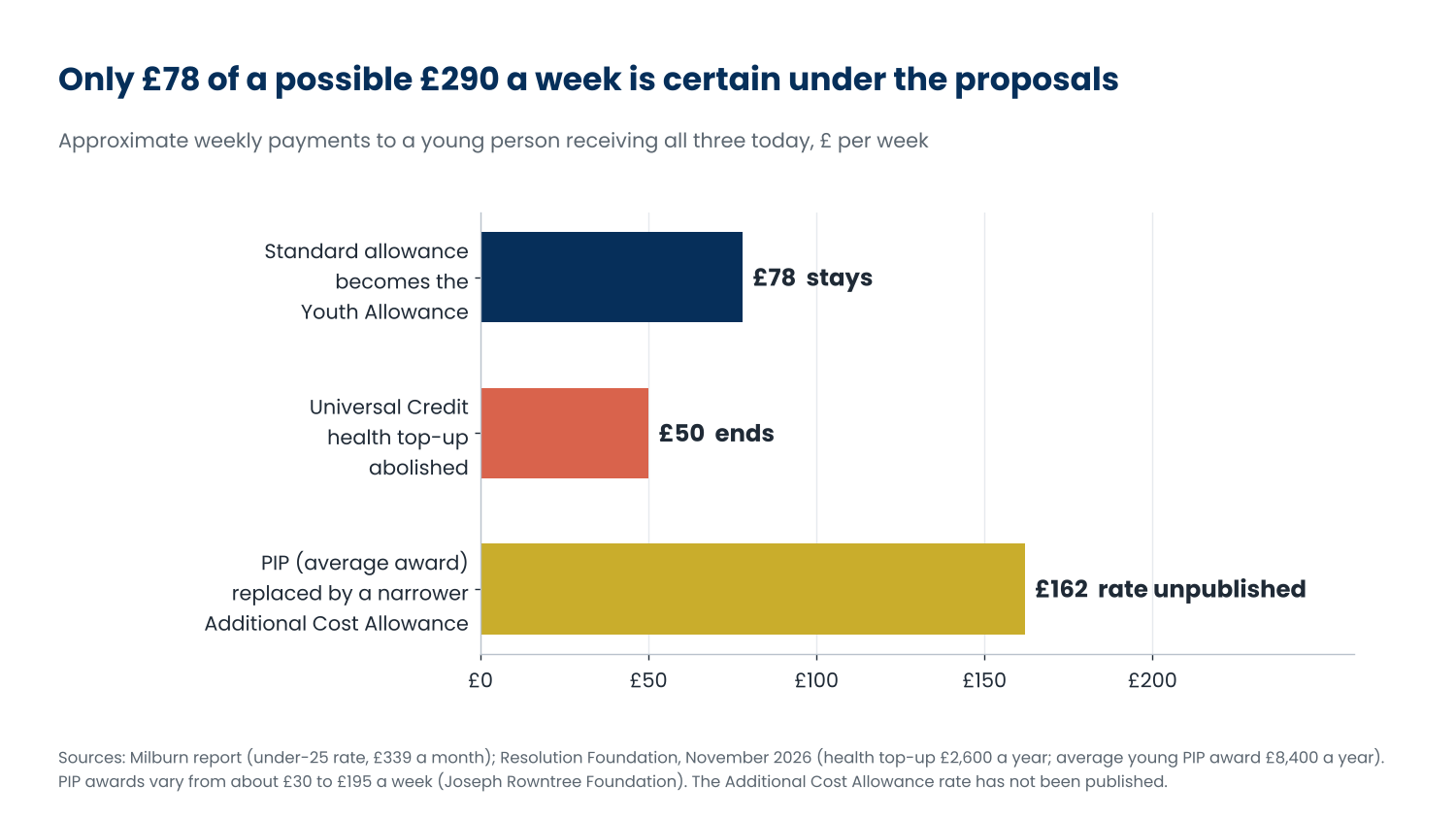
The report publishes no rate for the Additional Cost Allowance, so nobody can yet calculate a loss or gain. What we can show is what is paid now. The Resolution Foundation puts the health top-up for new claimants at £2,600 a year, about £50 a week, and the average PIP award for a young person at about £8,400 a year, about £162 a week (Resolution Foundation, November 2026). The Joseph Rowntree Foundation estimates PIP at between £30 and £195 a week (Brit Brief, November 2026).
A young person receiving all three payments today therefore gets roughly £290 a week. Under the proposals, only the £78 is certain. Whether the rest is replaced depends on a test and a rate that have not been written.
Why autism and ADHD sit at the centre
The report covers every young person out of work. Autism and ADHD still run through it, for three reasons.
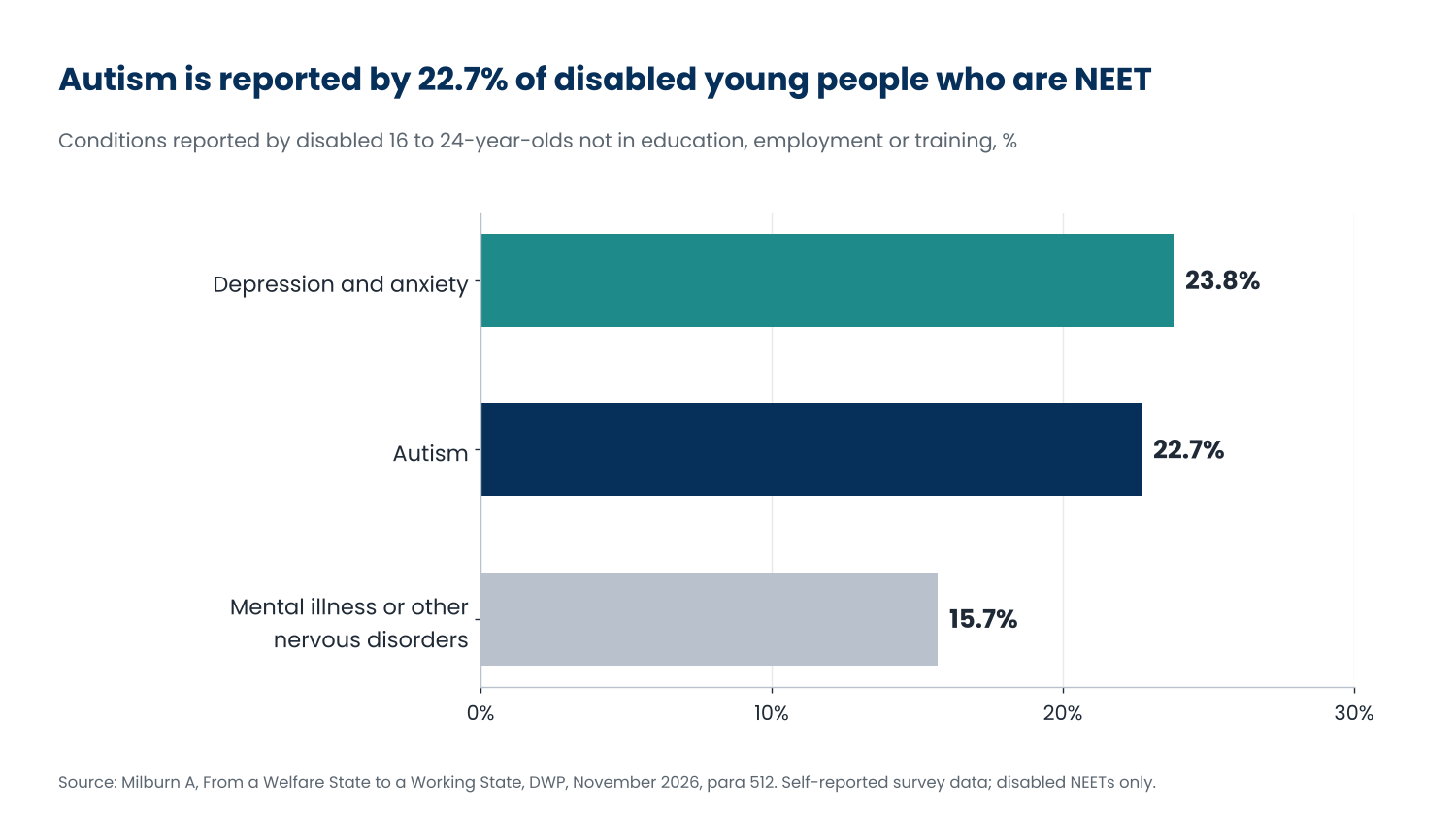
They are a large share of disabled young people who are NEET. Among disabled NEET young people, 22.7% report autism, almost level with depression and anxiety at 23.8%. Those whose main condition is a learning difficulty or autism rose from 7.7% to 12.3% of NEETs since 2021 (para 512).
They drive new claims. Anxiety, depression, ADHD and autism account for almost two in three new disability benefit claims among 16 to 24-year-olds (para 95). The number of young people on DLA or PIP has doubled to more than 400,000, and the report projects about 820,000 within ten years (para 633).
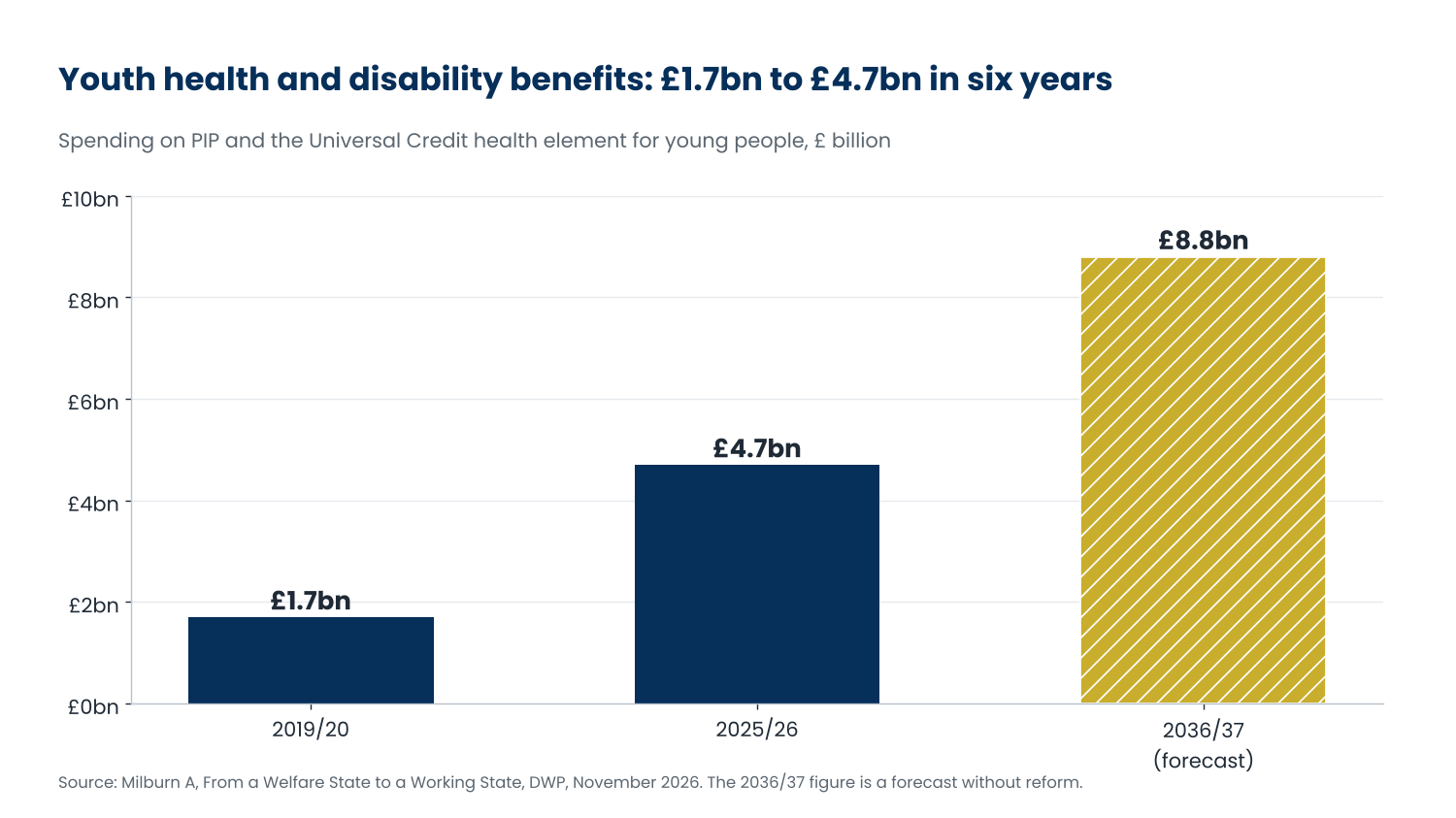
The cost is rising fast. Spending on health and disability benefits for young people grew from £1.7bn in 2019/20 to £4.7bn in 2025/26. The report forecasts £8.8bn by 2036/37 without reform (Chapter 6).
Milburn argues that worsening health cannot explain this alone. The disabled working-age population grew by about 17% between 2019/20 and 2023/24, while the number receiving incapacity or disability benefits grew by 46% (para 95). He leans on the government's independent review of mental health conditions, ADHD and autism, led by Professor Peter Fonagy, which found that the underlying prevalence of ADHD and autism is largely flat while diagnosis has risen sharply (para 514).
Peer-reviewed research points the same way on diagnosis. A study of UK GP records found a 787% rise in recorded autism diagnoses between 1998 and 2018, which its authors attributed mainly to increased reporting and application of the diagnosis (Russell et al., 2021).
Where these figures need care
22.7% does not mean a quarter of NEET young people are autistic. It is the share of disabled NEETs who report autism, drawn from self-reported survey data.
"Two in three" bundles four conditions together. The report gives no separate figure for autism or ADHD. Anxiety and depression may account for most of it.
"Flat prevalence" is one review's reading. The same review largely rejects the term "overdiagnosis", because it implies people's difficulties are not real (para 513). The Russell data stops at 2018.
Most young PIP recipients are not NEET. Almost two-thirds are already in work or education, according to the Resolution Foundation. PIP is not an out-of-work benefit, so a NEET review is an odd place to redesign it.
£8.8bn and 820,000 are projections. The report describes its numbers as its own estimates, not government spending commitments (para 945).
One survey figure will be quoted a lot. The report cites Resolution Foundation analysis that 21% of 16 to 24-year-old PIP recipients reported little limitation and no extra costs (para 755). That is self-reported, and it means roughly four in five reported the opposite.
Diagnosis, assessment and what we have seen ourselves
The report is blunt about diagnosis. It says a diagnosis can be life-changing when it unlocks the right support, but that in many places it has wrongly become the only key to help. That pushes people to seek one (paras 516 and 526).
It then turns on providers like us. Independent providers now carry out more than half of NHS-funded ADHD assessments and more than a third of autism assessments, and independent-sector ADHD spending has risen by about 252% in three years (para 527). The report describes a private market willing to give positive diagnoses and says some providers diagnose nearly everyone they assess. It labels that last claim anecdotal (para 526).
Its remedies follow from that:
Help without a label. Young people with possible ADHD or autism should get practical support without waiting for a formal diagnosis (paras 546 and 562).
Pay for quality, not volume. By 2028, NHS payment for assessments should rest on quality and outcomes. Providers that fail standards should lose NHS funding (paras 603 and 604).
Shorter waits. The median wait for an autism assessment for under-18s is almost 600 days, five times the 2019 figure (para 529).
We should declare an interest. We are a private practice. We hold no NHS contract, so every assessment we carry out is privately funded and we do not take Right to Choose referrals. Read what follows with that in mind.
That is a deliberate choice. In our view, assessment standards vary too much between providers that hold Right to Choose contracts, and the inconsistency confuses people who are seeking an assessment. We also believe cost pressure from some NHS trusts is pushing providers to cut corners, which does not serve clients. We are proud of the assessment standards we have developed over the past 16 years.
Not every client leaves us with a diagnosis. We make clear at the start that people are funding an assessment, not a desired outcome. We suspect not every provider holds itself to that standard, and on this point the report's concern is ours too.
What our own referrals show. Over the past two years, PIP has been mentioned specifically in about one in 20 of the referrals we receive. In the three years before that, we recorded none. This is our own review of our own referrals. It is not audited, it comes from one practice, and a mention of PIP is not proof of anyone's motive.
Most of those people were asking an honest question: is autism or ADHD part of my story? A minority were not. They wanted a diagnosis to support a funding application before anyone, themselves included, had looked at what they struggle with or what support would help. In our opinion that was wrong.
We say that carefully. People in financial hardship are right to ask what help exists, and the National Autistic Society has warned that public debate spends too much time questioning why people seek a diagnosis and too little on their distress (National Autistic Society statement, spring 2026). We agree with them.
Our objection is narrower. An assessment answers a clinical question about a person: how they think, what they find hard, what would help. PIP was never a payment for a diagnosis. The DWP's own claim form says it is assessed on how a condition affects you, not on the condition itself (DWP, PIP2 information booklet). The proposed Additional Cost Allowance would also test costs and needs, not conditions. A diagnosis sought only as a funding document was a weak route before. Under these proposals it would be weaker still.
We would like to hear from you. Have you felt you needed a diagnosis before a school, an employer or the benefits system would help? Did getting one change anything? Tell us. If we have this wrong, we want to know.
What charities and specialists are saying
Reaction on publication day splits in a consistent way. Almost everyone welcomes the employment support. The worry is the money.
National Autistic Society. A spokesperson said the new system would only work for autistic people if everyone supporting them has a very high level of autism training and understanding. The charity also said autistic people must not lose existing benefits until there is clear evidence the new system works (Brit Brief, November 2026).
Scope. James Taylor, executive director of strategy, welcomed the ambition on employment support but said the charity is "deeply concerned" that some young disabled people could end up with less. PIP covers extra costs whether or not someone works, he argued, so removing it could make work harder to reach (The Independent, November 2026).
Mencap. Chief executive Jon Sparkes called the report a once-in-a-generation chance to back young people. He said young people with a learning disability want to work but rarely get tailored support, and asked for a secure safety net (FE News, November 2026).
Sense. The charity wants assurances that young people with complex needs will not be left worse off (IBTimes UK, November 2026).
Action for Children. Lucy Schonegevel, director of influencing and impact, said the evidence shows that cutting financial support increases poverty, and that no struggling young person should be made poorer by reform (Big Issue, November 2026).
Association of Colleges. Chief executive David Hughes said colleges are ready to take a bigger role from age 14 and to enrol more 16 to 19-year-olds (FE News, as above).
Resolution Foundation. Chief executive Ruth Curtice backed the scale of ambition. The think tank says the welfare changes will be the most contested part of the review while playing a fairly small part in cutting the NEET rate, and that disability benefit rules should be settled after the Timms Review and applied to all ages (Resolution Foundation, as above).
Two gaps are worth recording. When we wrote this, we could find no published response from ADHD UK, Ambitious about Autism, IPSEA or Natspec. And the report's acknowledgements thank the National Autistic Society, but we could find no ADHD-specific charity among the organisations named. For a report that names ADHD as a driver of claims, that is worth asking about.
What it could mean for neurodivergent young people
The facts in this section come from the report. The judgements about risk are ours.
If your child is under 16 and gets DLA. Child DLA would continue to 18, with no reassessment at 16 and a transition plan agreed by 18. Today about 77% of child DLA claimants move on to PIP by 17 (paras 759 to 762). That route would close.
If you are 16 to 24 and get PIP now. Nothing changes until Parliament legislates. After that, you would move at your scheduled reassessment, with six months of preparation first and payments continuing in the meantime. The report's own timeline puts the first moves in 2029 (para 942).
If autism or ADHD brings clear, continuing costs. The Additional Cost Allowance is designed for you: support workers, specialist equipment, transport you cannot avoid. Evidence of the cost will matter more than the name of the condition.
If your award rests on needs that are hard to price. We think this group carries the most risk. Many autistic and ADHD young people qualify for PIP through prompting, supervision, planning and coping with overwhelm. Those needs are real, but they do not come with receipts. The local fund is discretionary, and the allowance's test is unwritten.
If paid work is not realistic. Severe and Complex Needs Insurance would give a stable, long-term income set above today's maximum benefit rates. The report says the bar to qualify would be very high.
Whoever you are, the adviser matters. Everything runs through a Youth Opportunity Service adviser. One who reads autistic burnout or ADHD-related disorganisation as refusal could start a path to sanctions. The National Autistic Society's call for autism training is the right one.
What happens next
A White Paper. The 2026 Budget says the government will publish one early next year, responding to both Milburn and the Timms Review of PIP (Budget 2026, October 2026).
A decision. Ministers have not adopted the recommendations. Pat McFadden told the BBC that some future claimants would not get what they would get today, but did not commit to Milburn's exact design (Big Issue, as above).
A vote. Six Labour backbenchers, including Nadia Whittome and John McDonnell, have already warned against reducing support for young people (IBTimes UK, as above). In 2025, ministers dropped PIP changes after a backbench revolt.
A rollout. If legislation passes, new claims switch from 2029 in areas with a Youth Opportunity Service, and existing claimants follow over up to five years (para 942).
For families, three practical points follow.
Today's rules still apply. Existing awards continue, and a claim made now is decided under the current system.
Keep evidence of impact and cost. PIP turns on daily living and mobility. The new allowance would turn on significant, continuing costs. Records of both will serve you under either system.
Seek an assessment for the right reason. A good assessment tells you how you or your child thinks and what will help. Our earlier post explains how private autism assessments are treated.
The short version
Milburn would end PIP and the Universal Credit health top-up for under-25s, replace them with a basic allowance plus a narrower costs payment, and spend the savings on getting young people into work. Autistic young people and those with ADHD are the group he most wants to move. He is right that a diagnosis should not be the price of help. He has not yet shown what an autistic 19-year-old with real but unreceipted needs will be paid, and until the White Paper answers that, no family can plan.
References
All sources were checked on 17 November 2026. Paragraph numbers refer to the Milburn report.
Official reports and guidance
Milburn A, Department for Work and Pensions. From a Welfare State to a Working State: A new settlement for the next generation. 17 November 2026.
HM Treasury. Budget 2026. October 2026.
Department for Work and Pensions. PIP2: How your disability affects you, form and information booklet.
Peer-reviewed research (found via Consensus)
Russell G, et al. Time trends in autism diagnosis over 20 years: a UK population-based cohort study. Journal of Child Psychology and Psychiatry, 2021. Abstract only.
Charities and research groups
Resolution Foundation. Government must match Milburn's ambition to properly invest in young people. 17 November 2026.
National Autistic Society. Response to the interim report of the independent review into mental health conditions, ADHD and autism, as published by Ucan2 Magazine. Spring 2026.
News reports
Brit Brief. Milburn Report: Young People With ADHD and Autism 'Expected to Work'. 17 November 2026. Source for the National Autistic Society response and the Joseph Rowntree Foundation estimate.
Maddox D, Toth A. Work, not welfare, is the future, Alan Milburn says as he unveils plans to end Neets crisis. The Independent, 16 November 2026. Read through the Yahoo News syndication.
FE News. Milburn Review to set out plan to move from a Welfare State to a Working State for the next generation. 16 November 2026. Sector reaction section.
McRae I. Milburn Review: Could disability benefit cuts for young people cost the government more than it saves? Big Issue, 17 November 2026.
Fantonial J Y. Andy Burnham Urged to Spend Billions on Youth Jobs as Milburn Proposes Disability Benefit Cuts for Under-25s. IBTimes UK, 17 November 2026.
Our own data
Family Practice Group. Internal review of initial referrals, 2021 to 2026. Unaudited.